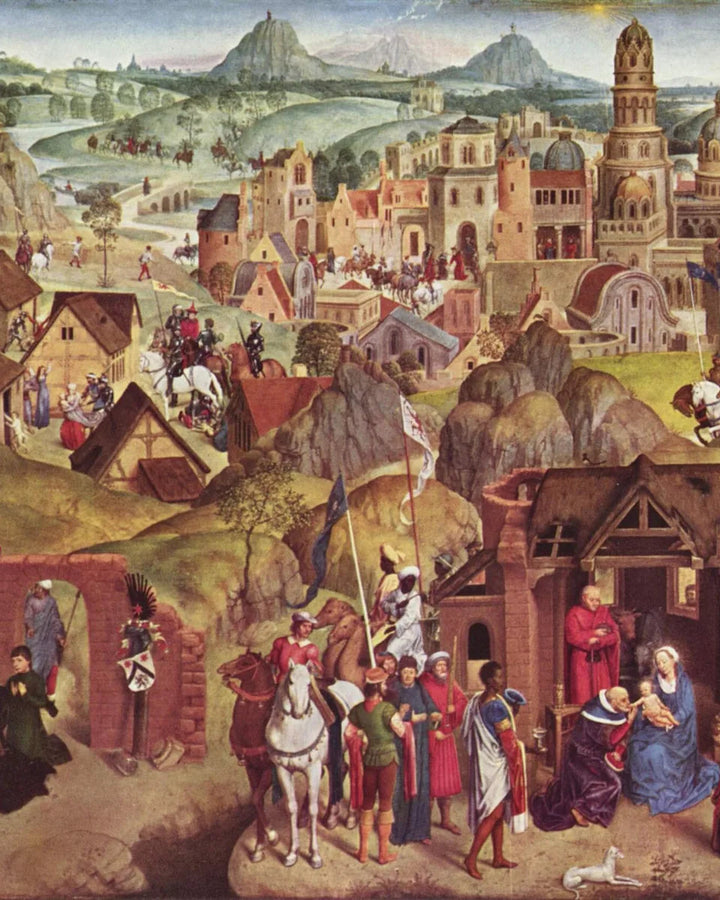
Jesus walking on water paintings: what the scene means
One night in Matthew 14, the painters who kept coming back to it, and how to tell which moment of it belongs on your wall.
In this article
It is somewhere between three and six in the morning. Twelve men have been rowing since dark, the wind is in their faces, and the shore they were sent toward is nowhere. Then one of them sees a figure walking on the water.
That is the night every painting of Jesus walking on water is trying to hold. Painters have been drawing it for seventeen hundred years, and the reason is mostly Peter. He climbs out, walks, looks at the wind, and goes under. Most of us have met him in the mirror.
What actually happens in Matthew 14?
Jesus sends the disciples ahead by boat and goes up a mountain alone to pray. Hours later he walks out to them across the sea; Peter asks to come to him, takes a few steps, panics, sinks, and is caught by the hand.
The evening began with the feeding of the five thousand, in the busiest stretch of his years in Galilee; if you want to see where it falls in the whole life of Christ in order, it sits right in the middle. Matthew says Jesus "constrained" the disciples to get into the ship and go ahead while he sent the crowds away (Matthew 14:22, KJV). By the time he comes down, the boat is in the middle of the sea, "tossed with waves: for the wind was contrary" (Matthew 14:24, KJV).
Hours pass. Then:
And in the fourth watch of the night Jesus went unto them, walking on the sea. And when the disciples saw him walking on the sea, they were troubled, saying, It is a spirit; and they cried out for fear. But straightway Jesus spake unto them, saying, Be of good cheer; it is I; be not afraid. (Matthew 14:25-27, KJV)
The fourth watch runs roughly from three to six in the morning. The disciples do not see a comfort. They see something upright on the water in the dark, and they take it for a ghost. The first thing Jesus does is speak.
Peter answers him. If it is really you, tell me to come to you on the water. Jesus gives him one word.
And he said, Come. And when Peter was come down out of the ship, he walked on the water, to go to Jesus. But when he saw the wind boisterous, he was afraid; and beginning to sink, he cried, saying, Lord, save me. And immediately Jesus stretched forth his hand, and caught him, and said unto him, O thou of little faith, wherefore didst thou doubt? (Matthew 14:29-31, KJV)
They climb into the boat together, the wind drops, and the men in the ship worship him as the Son of God. It is one night in a ministry full of them, and if you want the rest told plainly, here is what Jesus did, act by act.
One thing to know before you look at any painting. Three Gospels tell this night, and only Matthew has Peter on the water. Mark 6:45-52 and John 6:16-21 both have Jesus walking on the sea and the disciples afraid, but nobody leaves the boat. If Peter is in the picture, you are looking at Matthew.
Why does this story get to people the way it does?
Because it is about being afraid, and you have been afraid. The disciples fear the storm, then the figure on the water; Peter fears the wind once he is out on it. Every fear in the passage is answered the same way, with a voice and then a hand.
Many readers see their own week in that boat. You did what you were told to do. It is still hard, and the wind is still against you.
Jesus does not show up at dusk when the rowing starts; he comes in the fourth watch, after hours of it, and that has steadied a great many people who felt help was running late.
Maybe that is the kitchen at eleven at night with the checkbook open, or the drive home from the oncologist, or a son who has not called in a month. The boat is wherever you are still rowing.
Then there is Peter. He asks, he climbs out, he walks, he sinks. People have argued for centuries whether stepping out was faith or showing off, and the text leaves it open. Jesus calls him a man of little faith, which is not the same as none.
What is clear is what Peter says when the water closes over him. Lord, save me. No explanation, no bargaining. It may be the shortest prayer in the Gospels, and the answer comes "immediately."
Painters love the scene for all of that, and for one more reason. Few moments in the Gospels look like anything in particular. This one looks like a night sea.
How have painters shown it over the years?
Since the very first Christian art, and each age has picked a different second to freeze. The early images show the rescue; the marine painters of the 1800s cared more about the sea.
One of the oldest Christian buildings still standing, the house church at Dura-Europos in what is now Syria, was painted around the middle of the third century. One wall of its baptistery, the room where converts were baptized, is generally read as Christ and Peter on the water; how painters have shown the baptism of Christ is a separate story.
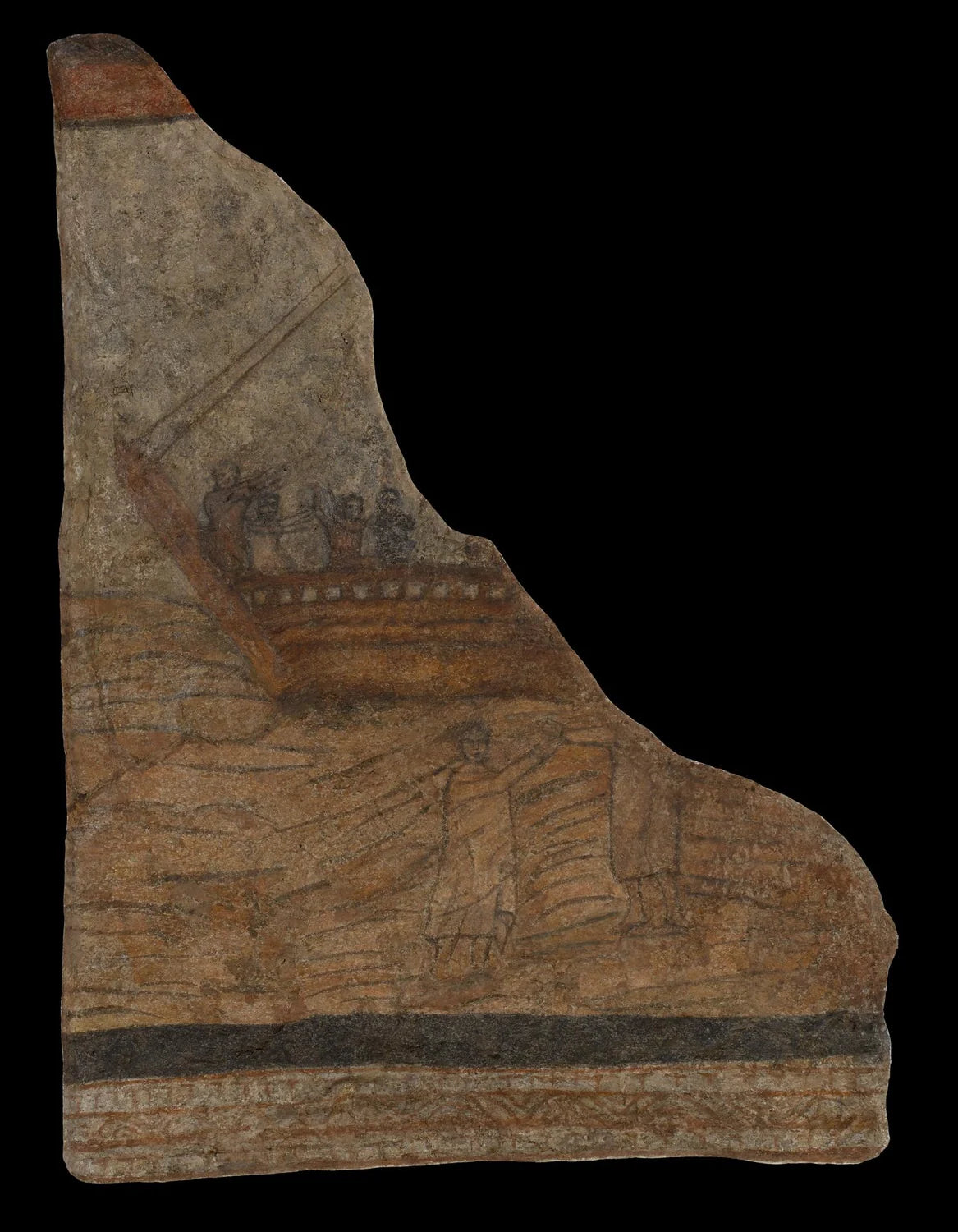
From there the scene turns up in Byzantine and medieval cycles of the miracles, kept simple: a boat, the disciples, Christ on the waves, Peter reaching.
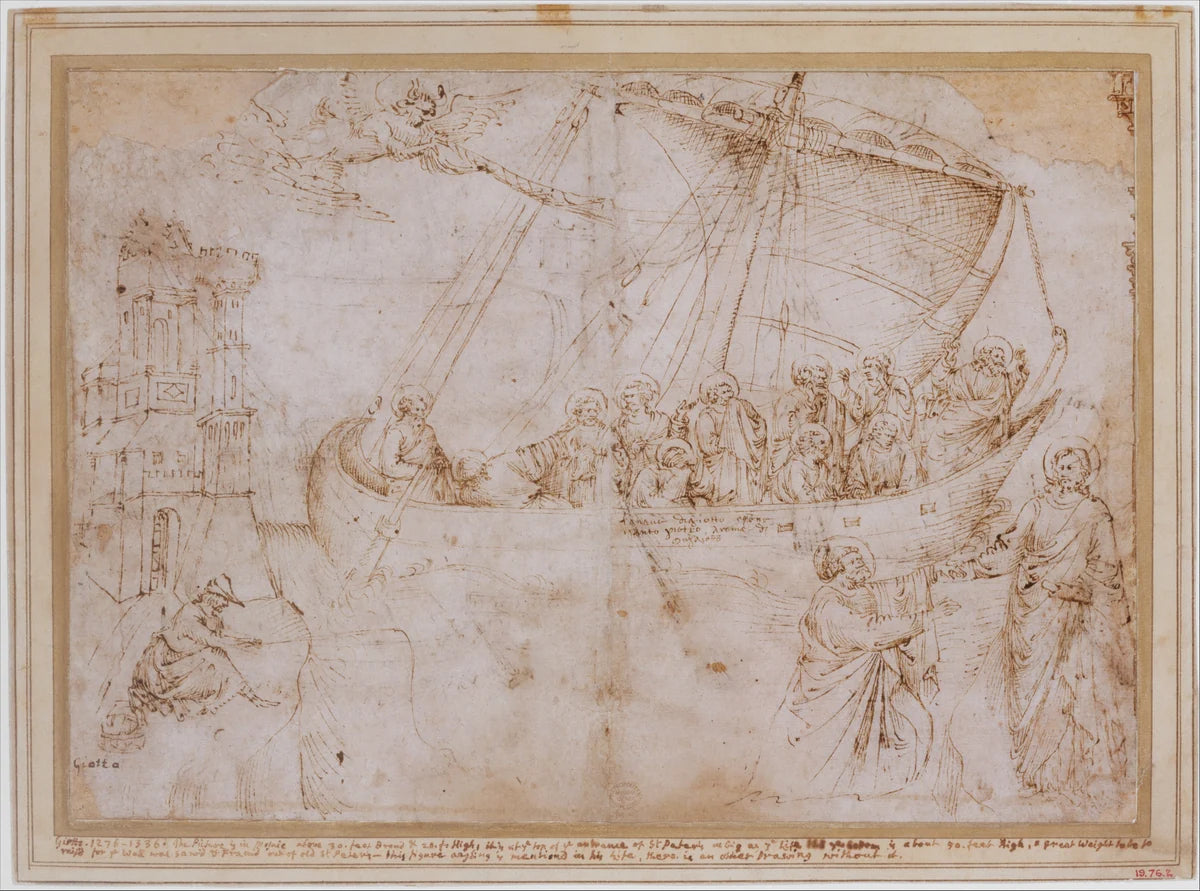
Around 1300 Giotto designed a large mosaic for Old St. Peter's in Rome. It was called the Navicella, the little ship, and it showed the apostles' boat in the storm and Christ taking hold of the sinking Peter.
The original was almost entirely lost when the basilica was rebuilt, and we know it mostly from copies, but for centuries it was the picture of this scene in Europe.
By the nineteenth century the sea painters had it. Ivan Aivazovsky, the Russian marine painter, made his "Walking on Water" in 1888, and in his version the water and the night sky are the real subject.
Christ is a small lit figure, the boat is off to one side, and the glow around him is the only bright thing on the canvas.
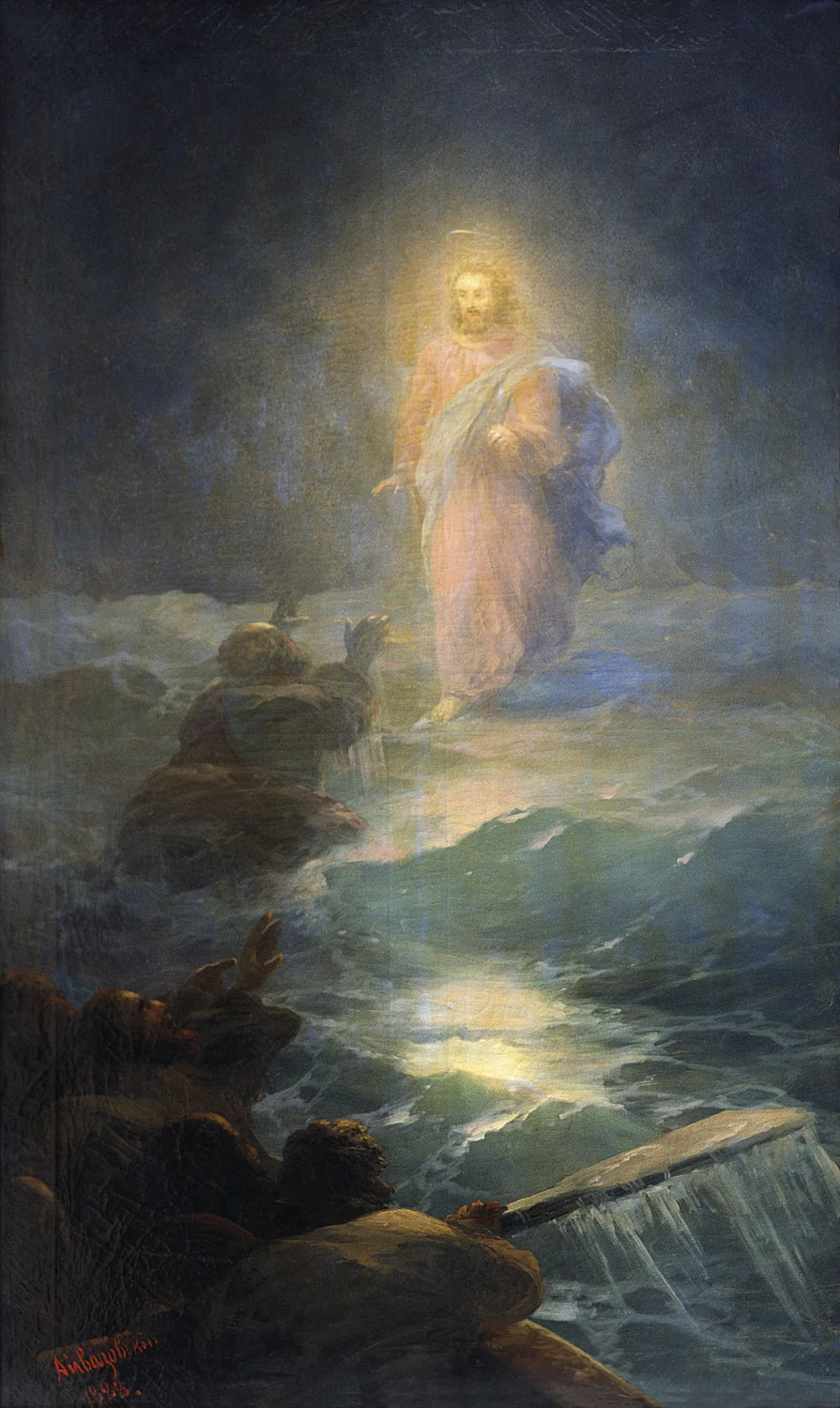
Every one of these painters had to choose. You can paint the arrival, or Peter's walk, or the catch, the hand closing on his arm. Each is a different sermon.
What should I look for in a Jesus walking on water painting?
Three things: where the light comes from, where the horizon sits, and how far apart the two figures are. Those choices tell you what the painter thought the night was about.
Light first. It is the fourth watch, so the sky can be anything from full black to the first gray before dawn.
Some painters keep it dark and let Christ be the only light, so he is plainly the center. Others paint a pale breaking sky and let the light fall on the water, which feels more like morning than rescue.
Neither is wrong. Ask which one you want to see with your first coffee.
Then the horizon. A high horizon fills the canvas with sea and the waves become the story; you feel the weight of the water and how small the boat is. A low horizon gives you sky, and the mood lifts.
Last, distance. Jesus and Peter close together, hand nearly on hand, is a picture about rescue. Jesus still some way off, walking toward a boat you can barely make out, is a picture about approach: help on its way and not yet there.
For a particular room, this is the question that decides it. Do you want the moment of being caught, or the moment of watching him come?
One practical thing. The passage is full of motion, so a lot of paintings of it are busy. For a room where you go to rest, look for one that leaves some quiet in the frame.
How does Above the Waves show it?
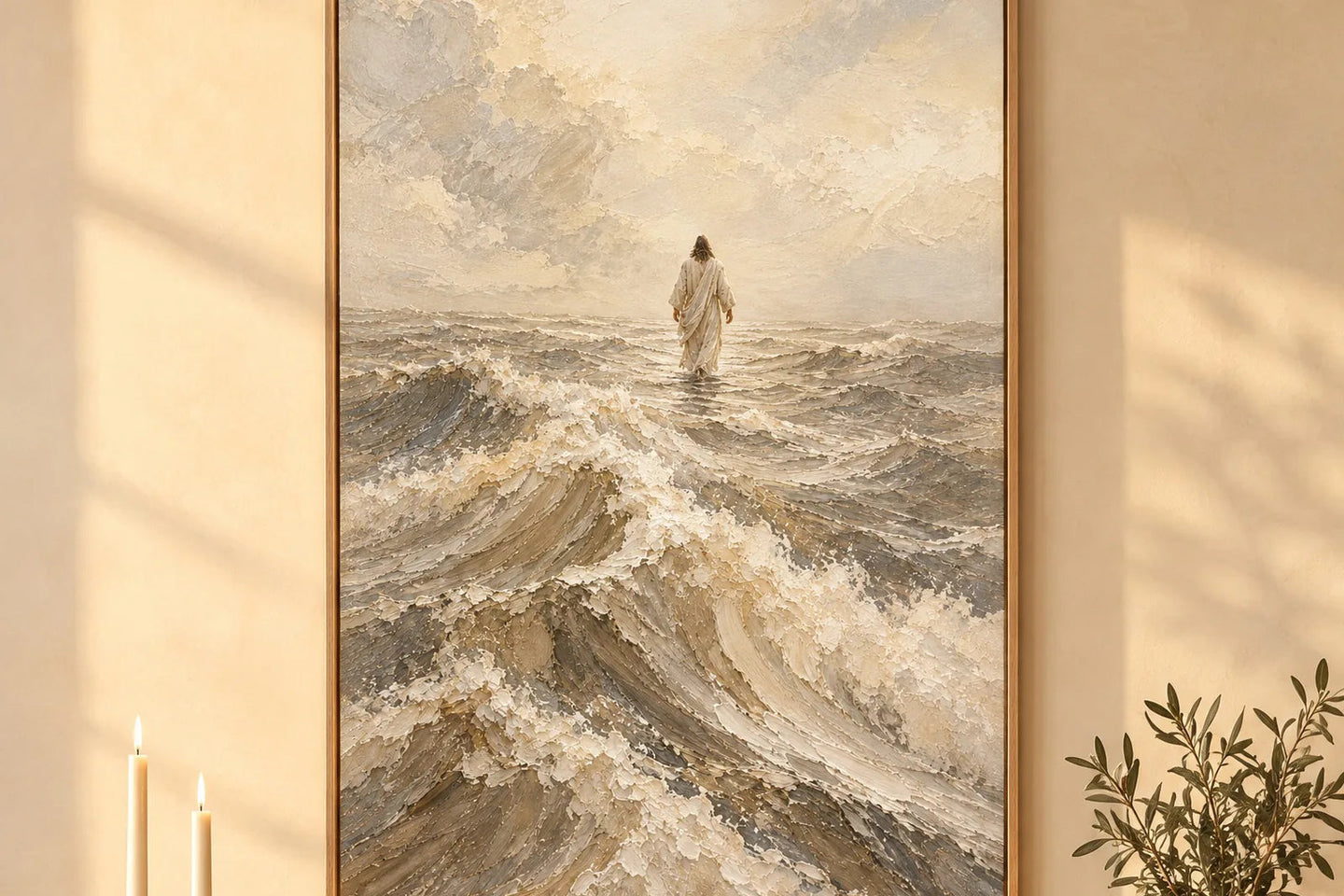
Above the Waves takes the approach. Jesus is walking away from you across a pale, restless sea, toward a boat you cannot see. You stand behind him, looking where he is looking.
We chose that on purpose. Most paintings of this night put you in the boat, watching him come. Here you are out on the water with him, a few steps back, and the boat is somewhere ahead in the gray.
The waves in the foreground are heavy, thick strokes that are part of the printed image, and they settle toward the horizon into a calmer surface where he stands. The colors are oyster, slate and soft ivory. The light is the even, pearled light of the last hour before sunrise, not a beam from heaven.
The painting reads the passage the way many people do on their own: the storm is not over, and he is walking through it anyway. It is not a rescue picture. It is what steadiness looks like on unsettled water.
From across a living room or an entry it reads calm. Up close the texture rewards you, and on the big sizes the waves take on their full weight while the figure at the horizon stays small, which is how it was meant to be seen. If you are thinking of it for a man who has come through his own storm, our guide to Christian gifts for men, chosen by the life he leads sets it beside other gifts made to last.
What about the next moment, Reaching Through the Water?
Reaching Through the Water picks up at verses 30 and 31, when Peter has gone under and a hand comes down for him. Same night, same sea, painted from below the surface.
Where Above the Waves is quiet and pale, this one is deep teal and sea blue, with warm ivory light breaking through from above. You are looking up from under the water, in Peter's place. Bubbles rise past you.
Jesus leans over the surface with the light behind him, and his hand comes down through it, open, close enough to take. The painting holds the instant between "Lord, save me" and "immediately."
The two belong together. One is the approach, the other is the catch. Side by side, or in two rooms of the same house, they tell the passage in order. We have written separately about the story behind Reaching Through the Water and why the reaching hand became so loved.
Where would I hang it?
In the room where the worry lives. For most of us that is not the living room. It is the kitchen table where the bills get opened, the desk in the spare room, or the hallway you walk at two in the morning when sleep will not come.
Above a desk is one of the best spots. You look up from the screen and the sea is there, and so is he. A 16 by 20 or 20 by 30 sits well there without crowding.
In a hallway a taller piece works because you approach it walking, which suits a painting about walking. In a bedroom the pale approach image is easier to fall asleep under than the deep blue rescue.
Over a sofa, go bigger than you think, and if you want the numbers, we have worked out what size art goes above a sofa. A 24 by 36 or 30 by 40 holds the wall on its own; much smaller and it looks as if it is floating.
Frameless suits the painterly surface of these two, and a natural or black pine frame gives a more finished edge in a formal room. Both come with the hardware, so the only decision left is which wall.
Both pieces are with the rest of our Jesus wall art, in one place.
One last thing before you choose
The passage ends with the wind dropping and the men in the boat worshipping. It does not end with Peter never being afraid again; later in the same Gospel he is afraid in a courtyard. That is why this scene belongs in a house and not only in a museum.
It is not a picture of someone who never sinks. It is a picture of what happens when one of us does.
Whichever moment you hang, the approach or the catch, it has one small job: to be the thing your eye lands on when the wind is contrary, and to say, in the words of the passage, be of good cheer. Then you turn off the kitchen light and go up to bed.
Frequently asked
Which Gospels tell the story of Jesus walking on water?
Three. Matthew 14:22-33, Mark 6:45-52 and John 6:16-21 all have Jesus walking on the sea and the disciples afraid. Only Matthew has Peter leaving the boat. Luke skips the episode.
Did Peter actually walk on water?
Matthew says so. Verse 29 says he "walked on the water, to go to Jesus" (Matthew 14:29, KJV) before he saw the wind and began to sink. How far he got is not said, and Mark and John do not mention his walk, so the detail rests on Matthew alone.
What does Jesus walking on water symbolize?
The text gives one meaning plainly: the men in the boat conclude that Jesus is the Son of God. Beyond that, many readers see the boat as ordinary life with the wind against it, the walk as faith, the sinking as doubt, and the hand as grace. Those are readings the passage can hold, but it does not state them.
What size painting works above a sofa?
For a three-seat sofa, 24 by 36 or 30 by 40 is the usual choice. A good rule is that the art spans about two-thirds of the sofa's width, with its bottom edge eight to ten inches above the back cushions. For a loveseat, 20 by 30 works well.
Passages cited: Matthew 14:22-33 (quoted: 14:22, 14:24, 14:25-27, 14:29-31, 14:29); Mark 6:45-52; John 6:16-21.

Mercy & Light
Mercy & Light makes art and books of Scripture for the home, crafted with care and made to be kept for a lifetime. Every article names the passage it rests on, and every reference is checked against the text before it is published. About us