
The life of Christ: the story of Jesus in order
The whole life of Jesus in the order the Gospels tell it, with a timeline, the passage for each moment, and the paintings that have kept it in front of us.
In this article
Most of us learned it in pieces. A manger at Christmas, a boat in a storm on some Sunday in July, a cross and an empty tomb at Easter. The life of Christ reaches us out of order, one story at a time, and it is easy to reach middle age without ever having laid it end to end.
So here it is end to end, the way the four Gospels tell it: where he was born, where he grew up, what he did in Galilee, why he went up to Jerusalem, and what happened there. Each moment has its passage beside it, so you can open your own Bible and read it for yourself.
What are the main events in the life of Christ?
Seven movements: the birth in Bethlehem, the hidden years in Nazareth, the baptism in the Jordan, the ministry in Galilee, the last road to Jerusalem, the Passion, and the Resurrection. Everything the Gospels record fits inside those seven.
Here they are in order, with the passages that tell them.
| Moment | Where | Main passages |
|---|---|---|
| Birth | Bethlehem | Matthew 1-2; Luke 2:1-20 |
| Flight and return | Egypt, then Nazareth | Matthew 2:13-23 |
| The boy in the Temple | Jerusalem | Luke 2:41-52 |
| Baptism and temptation | The Jordan, the wilderness | Matthew 3-4:11; Mark 1:9-13; Luke 3-4:13 |
| Ministry in Galilee | Capernaum, the Sea of Galilee | Matthew 4:12-18:35; Mark 1:14-9:50 |
| The road to Jerusalem | Judea, Jericho | Luke 9:51-19:27 |
| The last week | Jerusalem | Matthew 21-27; John 12-19 |
| Resurrection and Ascension | The garden tomb, Galilee, Bethany | Matthew 28; Luke 24; John 20-21; Acts 1:1-11 |
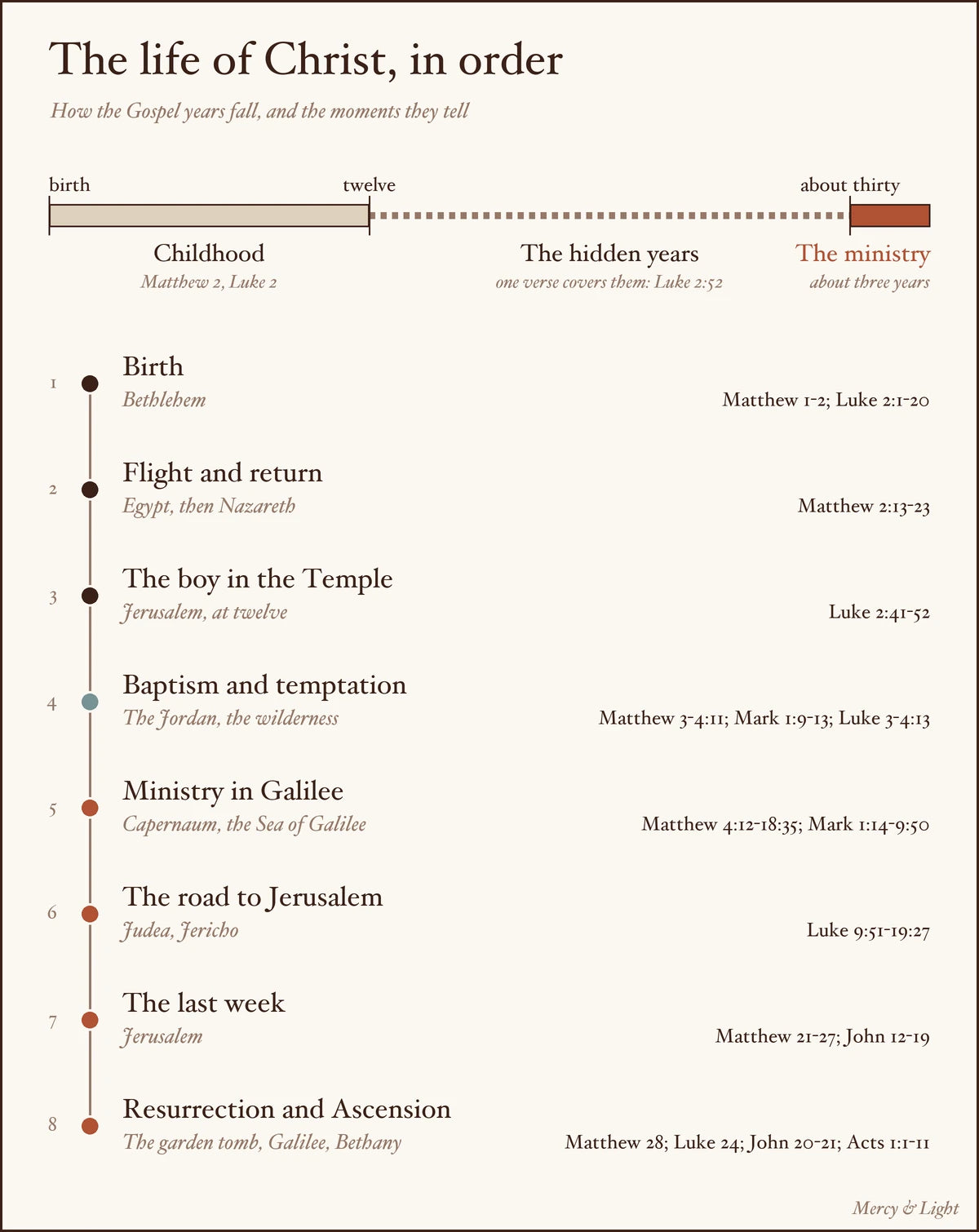
Two things help before you start. The Gospels are four portraits of one life, and they do not always put events in the same order; Matthew groups teaching by theme, and John follows Jesus up to Jerusalem for several feasts. And they are brief on purpose. John closes his with a line that is worth reading slowly.
"And there are also many other things which Jesus did, the which, if they should be written every one, I suppose that even the world itself could not contain the books that should be written." (John 21:25, KJV)
Where was Jesus born, and what happened next?
In Bethlehem, a small town a few miles south of Jerusalem, while Herod the Great was king of Judea. Most historians place the birth a few years before the year we number as one, because Herod died around 4 BC.
Luke gives us the part every Christmas card knows. Mary "brought forth her firstborn son, and wrapped him in swaddling clothes, and laid him in a manger; because there was no room for them in the inn." (Luke 2:7, KJV). Shepherds come in from the fields that night. Only Luke has the shepherds.
Matthew tells a different part of the same story. Wise men arrive from the east, Herod hears of a newborn king and turns murderous, and Joseph takes Mary and the child into Egypt until Herod is dead. Only Matthew has the wise men and the flight.
Nativity scenes put the shepherds and the wise men side by side in the same stable, and that is fine for a mantelpiece. Reading the life in order, it helps to keep them apart. The shepherds come the night he is born; Matthew's wise men find the family in "the house" (Matthew 2:11, KJV), some time later. Painters have joined the two scenes for centuries, and our guide to famous Nativity paintings and what they add shows where each borrowed detail comes from.
When the family comes back, they do not settle in Bethlehem. They go north to Nazareth in Galilee, a village so small it is never named in the Old Testament, and that is where he grows up.
What do the Gospels say about his years in Nazareth?
Almost nothing, and that silence is part of the story. Between the return from Egypt and the start of his ministry, the Gospels give us one scene and one sentence.
The scene is in Luke. At twelve, Jesus goes up to Jerusalem with his parents for the Passover, stays behind in the Temple, and is found three days later among the teachers, listening and asking questions. When his mother says they have been searching for him in sorrow, he answers, "wist ye not that I must be about my Father's business?" (Luke 2:49, KJV).
Then the sentence, which covers the next eighteen years or so: "And Jesus increased in wisdom and stature, and in favour with God and man." (Luke 2:52, KJV).
That is all. He lives in a village, in a family, with brothers and sisters the Gospels later name. In Mark the neighbours call him "the carpenter" (Mark 6:3). He learns a trade and grows up. Painters have always wanted more, and for centuries they have filled the gap with Joseph's workshop, shavings on the floor and a boy holding a plank, which is imagination laid over a single word. We have gathered everything Scripture says about Jesus growing up in Nazareth, verse by verse.
There is something steadying in those quiet years. Most of a life is spent the way his was spent then, in ordinary work in one small place. The Gospels do not treat that time as wasted, and neither should we.
How did his public ministry begin?
At the river Jordan, when he was about thirty. Luke is careful to say it plainly: "And Jesus himself began to be about thirty years of age" (Luke 3:23, KJV).
John the Baptist is preaching repentance in the wilderness, and crowds are going out to be baptized. Jesus comes down from Nazareth and asks to be baptized too. As he comes up out of the water, the Spirit descends like a dove, and a voice speaks: "This is my beloved Son, in whom I am well pleased." (Matthew 3:17, KJV).
The scene has been painted more than almost any other in the Gospels, and how painters have shown the baptism of Christ is a story of its own, from the catacombs to the Verrocchio panel in Florence where a young Leonardo painted one of the angels.
Straight from the river he goes into the wilderness for forty days, fasting, and is tempted there. Matthew and Luke both give the three temptations; Mark gives the whole episode in two verses. He comes out of the desert, John is arrested, and Jesus goes north into Galilee with a short message: "The time is fulfilled, and the kingdom of God is at hand: repent ye, and believe the gospel." (Mark 1:15, KJV).
What did Jesus do in Galilee?
He taught, healed, called disciples, fed crowds and forgave people nobody else would touch. Galilee is where most of the Gospel stories you know by heart take place, and for most of those years his base was Capernaum, a fishing town on the north shore of the lake. We have set out where Jesus lived, place by place.
Matthew sums up the whole period in one long sentence: "And Jesus went about all Galilee, teaching in their synagogues, and preaching the gospel of the kingdom, and healing all manner of sickness and all manner of disease among the people." (Matthew 4:23, KJV).
The first thing he does there is call fishermen. Peter and Andrew are casting a net into the sea when he tells them, "Follow me, and I will make you fishers of men." (Matthew 4:19, KJV). James and John leave their father in the boat with the hired men.
Then come the scenes that fill the middle of every Gospel. The Sermon on the Mount. The paralysed man let down through a roof. A woman who touches the edge of his garment in a crowd. A little girl told to get up. Five thousand fed from five loaves. The parables, told from boats and hillsides to people who worked the land and the water. We have gathered what Jesus did, act by act, with the passage for each, in a shorter piece.
And the sea itself, which keeps turning up. He sleeps through a storm in the stern of a boat and wakes to calm it. Another night he walks out to the disciples on the water, and Peter steps out to meet him and sinks; what happens on the water in Matthew 14 has kept painters busy for centuries, Rembrandt among them. His only seascape, The Storm on the Sea of Galilee, was stolen from a Boston museum in 1990 and has never been found.
Galilee is also where he names himself the shepherd. The image comes in John 10, where he says the good shepherd gives his life for the sheep, and we have written about why Jesus holding a lamb still moves people.
Why did he go up to Jerusalem?
Because that is where it had to end, and he knew it. Around the middle of Luke's Gospel the story turns south: "he stedfastly set his face to go to Jerusalem" (Luke 9:51, KJV), and from there on every mile is a mile closer to the cross.
He tells the disciples three times, plainly, that he will be handed over, killed and raised on the third day. They do not understand, and on the road they argue about which of them is greatest.
Before the turn there is the Transfiguration, when Peter, James and John see him on a mountain with his face shining and Moses and Elijah beside him. It reads like a glimpse of the end given before the hardest part begins.
On the way he passes through Jericho, where a tax collector named Zacchaeus climbs a sycamore to see him, and a blind beggar named Bartimaeus shouts until he is heard. He raises Lazarus at Bethany, a short walk from Jerusalem, and in John's telling that is what finally moves the authorities to act.
Then, a few days before Passover, he rides into the city on a donkey while the crowds spread their cloaks and cut branches from the trees. All four Gospels tell the entry. It is the one scene of public honour in his life, and it lasts an afternoon.
What happened in his last week?
In a few days he clears the Temple, teaches in its courts, eats the Passover with his disciples, prays in Gethsemane, is arrested, tried and crucified. The Gospels slow right down here; a large share of each one covers that single week.
At the Last Supper he breaks bread and gives the cup, and in John he washes his disciples' feet. Leonardo's Last Supper, painted on a refectory wall in Milan in the 1490s, catches the moment just after he says that one of them will betray him. Every face at the table is asking the same question.
That night in the garden he prays that the cup might pass from him, and then accepts it. Judas arrives with soldiers. Peter follows at a distance and denies him three times in a courtyard. By morning he has stood before the high priest, before Pilate and, in Luke, before Herod Antipas.
He is crucified outside the city walls. John records his last words from the cross: "It is finished: and he bowed his head, and gave up the ghost." (John 19:30, KJV). Joseph of Arimathea asks for the body and lays it in a new tomb cut in the rock, and a stone is rolled across the door.
What happened after the cross?
On the first day of the week, women come to the tomb with spices and find the stone rolled away. The angel's words in Matthew are the centre of the whole story: "He is not here: for he is risen, as he said." (Matthew 28:6, KJV).
Then come the appearances, which are some of the most human scenes in the Gospels. Mary Magdalene takes him for the gardener until he says her name. Two disciples walk to Emmaus beside him without knowing him, and recognise him when he breaks bread at their table; Caravaggio painted that supper twice.
Thomas is invited to touch the wounds. And on the shore of the Sea of Galilee, where it began, he cooks breakfast for fishermen who have caught nothing all night and asks Peter three times whether he loves him.
Luke says he "shewed himself alive after his passion by many infallible proofs, being seen of them forty days" (Acts 1:3, KJV). Then, near Bethany, he is taken up from their sight, and the disciples go back to Jerusalem with great joy.
Keeping the whole story within reach
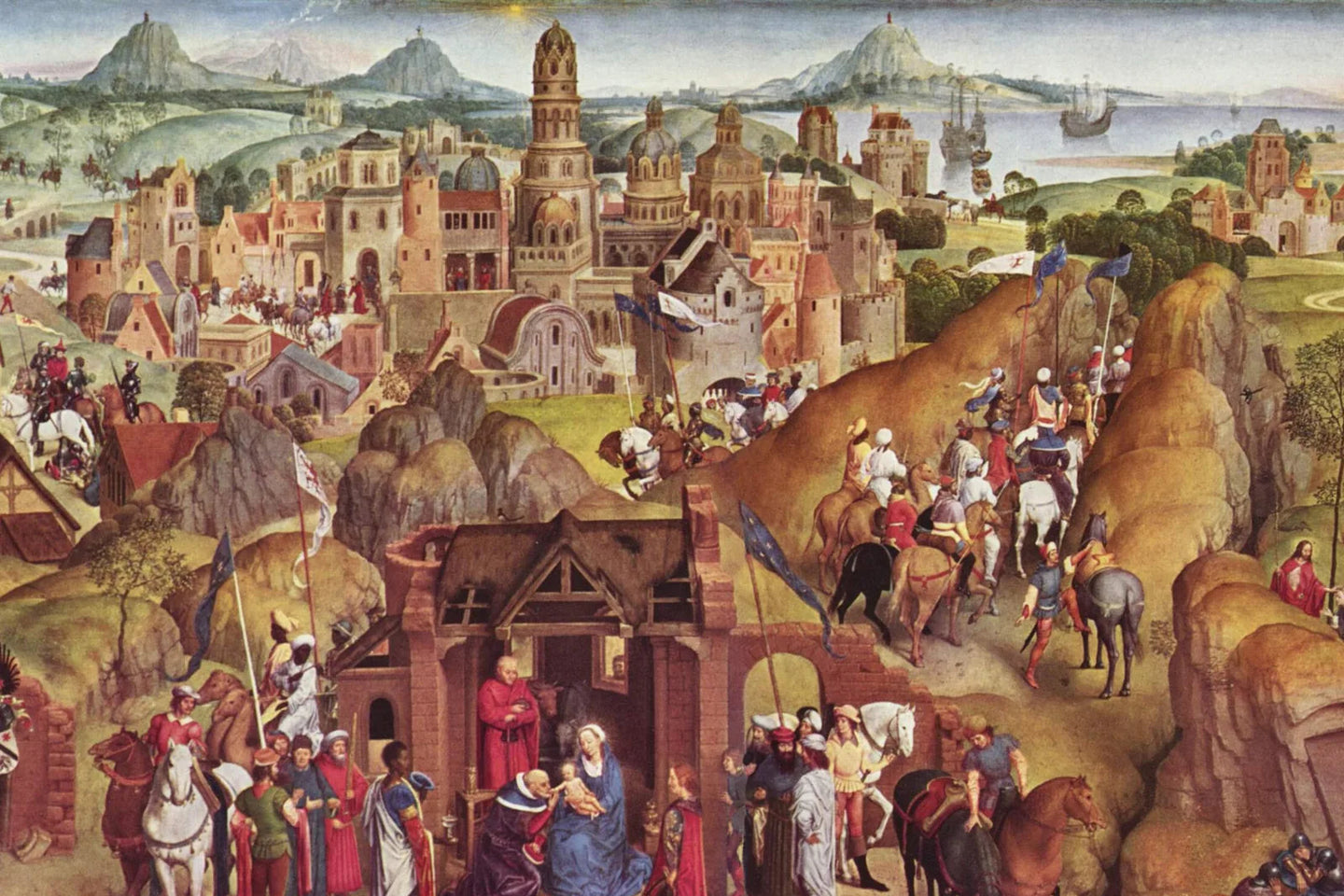
For most of history, people learned this life from walls rather than pages. In the Scrovegni Chapel in Padua, Giotto painted it around 1305 as a sequence of scenes running around the room, birth to Resurrection, so that you walk through the Gospel in order. Hans Memling did it on a single panel in 1480: his Advent and Triumph of Christ, at the top of this page, sets about two dozen scenes in one landscape, from the Annunciation to Pentecost. Many of the most famous paintings of Jesus and what each shows began as one scene in a series like that. Books carry the idea now; we compared seven illustrated lives of Jesus side by side.
That is what we tried to do with CHRIST, our coffee-table book: the life of Jesus in art and Scripture, each image beside the passage it shows, in the order the story is told. Galilee has its own spread, and so does the Good Shepherd. It is meant to sit on a table where someone can open it for five minutes and read one moment, then come back tomorrow for the next.
You do not need a book to do that, of course. A Gospel read one chapter a night will carry you from Bethlehem to the empty tomb in a few weeks, and our guide to books about Jesus, starting with the Gospels suggests what to read next. But a picture helps the story stay in the room once the Bible is closed, and our canvases and the book are all together in everything we make, in one place.
Wherever you keep it, the point is the same as Giotto's. Walk through it in order once, and every piece you meet on a Sunday afterwards will know where it belongs.
Frequently asked
How long was Jesus's public ministry?
About three years, by the usual count. John's Gospel mentions three Passovers during the ministry, which is where the traditional figure comes from. Matthew, Mark and Luke mention only the final Passover, so some scholars argue for a shorter ministry, but three years remains the common reading.
How old was Jesus when he died?
Probably in his early thirties. Luke says he was about thirty when his ministry began, and the ministry lasted from one to three years depending on how the Gospels are read. Most historians date the crucifixion to around AD 30 or 33.
What is the best Gospel to read first?
Mark is the shortest and the fastest, and it reads in one or two sittings. Luke is the fullest account of the birth and the most careful about order, which makes it a good choice for reading the life from start to finish. John is best read after one of the others, because it follows a different pattern and adds scenes they leave out.
Why do the Gospels tell some events differently?
Because they are four accounts written for different readers, each choosing what to include and how to arrange it. Matthew often groups teaching by subject, while Luke says he set out to write "in order" (Luke 1:3). The differences are mostly of selection and arrangement, and reading them side by side gives a fuller picture than any one alone.
Passages cited: Matthew 1-2 (quoted: 2:11); Matthew 2:13-23; Luke 2:1-20 (quoted: 2:7); Luke 2:41-52 (quoted: 2:49, 2:52); Mark 6:3; Luke 3:23; Matthew 3:17; Matthew 4:1-11; Mark 1:9-13; Mark 1:15; Matthew 4:12-25 (quoted: 4:19, 4:23); John 10:11; Matthew 14:22-33; Luke 9:51; Matthew 17:1-8; Luke 19:1-10; Mark 10:46-52; John 11; Matthew 21-27; John 12-19; John 19:30; Matthew 28 (quoted: 28:6); Luke 24; John 20-21; John 21:25; Acts 1:1-11 (quoted: 1:3); Luke 1:3.

Mercy & Light
Mercy & Light makes art and books of Scripture for the home, crafted with care and made to be kept for a lifetime. Every article names the passage it rests on, and every reference is checked against the text before it is published. About us


