
Canvas sizes explained: what size art goes above a sofa or bed
Our six canvas sizes and where each one belongs, plus the two rules that settle what to hang above your sofa or your bed.

In this article
You have the tape measure out and the sofa is 84 inches. Now what. Painting canvas sizes are written width by height in inches, and the right one comes down to two rules: art above furniture should be about two-thirds the width of that furniture, and its center should sit roughly 57 to 60 inches from the floor.
Above a standard sofa that usually means a 24x36 or a pair of 20x30s. Above a queen bed, a 30x40 or two 20x30s. Everything else is detail, and the detail is below.
Are there standard canvas sizes?
No. Art-supply canvases come in dozens of sizes, and print studios each settle on the handful that suit their work. Ours are six, all in a 2:3, 3:4 or 4:5 ratio and all vertical, because our scenes are composed in portrait format.
| Size (inches) | Ratio | Where it belongs |
|---|---|---|
| 8x12 | 2:3 | A shelf, a desk, a bedside table, or one piece in a small group |
| 12x16 | 3:4 | A hallway, an entry, a powder room, the wall beside a door |
| 16x20 | 4:5 | A bedroom wall, above a dresser or nightstand, a home office |
| 20x30 | 2:3 | Above a loveseat or armchair alone, or in a pair above a sofa or bed |
| 24x36 | 2:3 | Above a sofa or queen bed on its own, or a focal wall in a mid-sized room |
| 30x40 | 3:4 | A large room, a high ceiling, above a king bed or a sectional |
The first number is the width, the second the height. An 8x12 is eight inches wide and twelve tall.
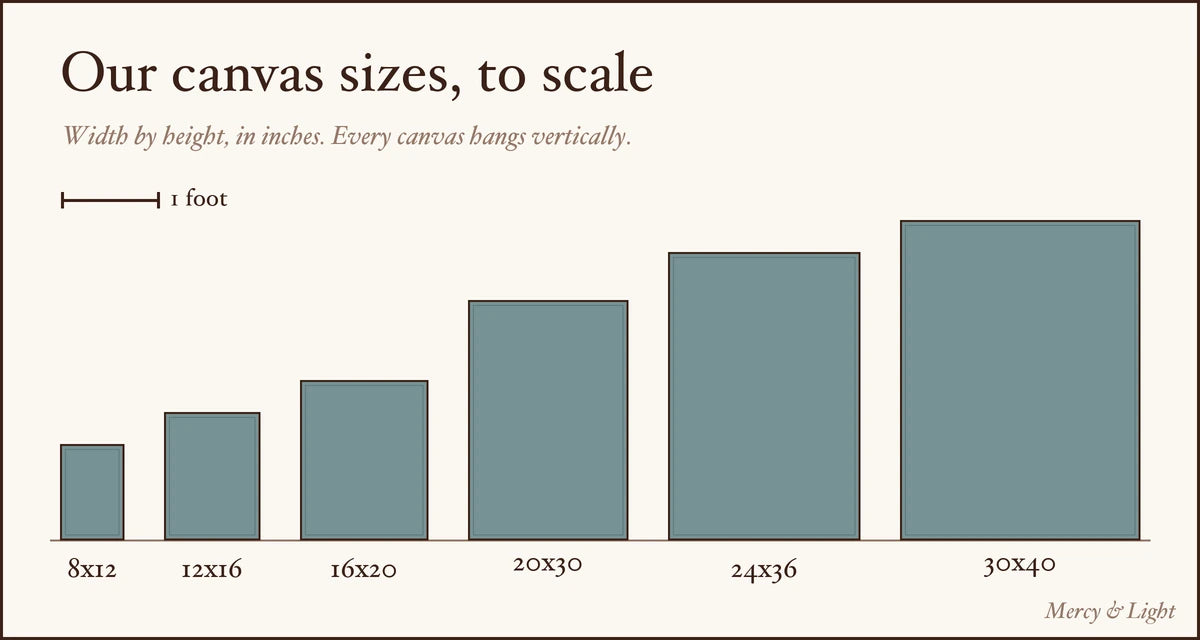
The jump from one size to the next is bigger than it looks on a phone. When you are torn between two, the larger one is right more often than not. Small art on a big wall is the most common mistake in a home, and the hardest to fix later, because you have already paid for the small one.
What size goes above the sofa?
About two-thirds of the sofa's width. A standard three-seat sofa is around 84 inches wide, so the art above it should span roughly 56 inches. A loveseat at 60 inches wants about 40.
With vertical canvases, that gives you two honest options. The first is a single large piece and some breathing room: a 30x40 or 24x36 centered above the sofa, with the wall on either side left bare. It works when the room is calm and the piece is strong enough to hold the wall alone; choosing the piece itself for a living room is the other half of the question.
The second is a pair. Two 20x30s hung about four inches apart cover 44 inches; two 24x36s cover 52. Pairs suit sofas because they follow its long shape without forcing a scene into a landscape format.
Hang the bottom edge six to ten inches above the back of the sofa. Closer than that and the art looks like it is sitting on the cushions; higher and the two stop belonging to each other.
What size goes above the bed?
The same two-thirds rule, measured against the headboard or the mattress. A queen mattress is 60 inches wide, so aim for about 40 inches of art: a pair of 20x30s, which spans 44, or a single 30x40 if you want one piece and some open wall on either side.
A king is 76 inches wide, which suits a pair of 24x36s or a single 30x40 with generous space around it. A full or twin bed takes a 24x36 or a 20x30 alone.
Bedrooms are where a vertical scene earns its keep. You see it lying down, from below, and from the doorway on your way in with the laundry, and a portrait format above a headboard rises with the wall instead of fighting the mattress for width.
Leave eight to twelve inches between the headboard and the bottom of the canvas, a little more than above a sofa.

How high do I hang it?
Center the piece at 57 to 60 inches from the floor. That is roughly the eye level of an average adult standing, and it is the height most galleries use. It will feel low the first time, because the habit in most homes is to hang art too high. Trust the tape measure over your instinct.
Above furniture, the rule bends. The relationship between the art and the sofa or bed matters more than the exact center height, so let the six-to-ten-inch gap set the position and accept a center that ends up a few inches above 60.
In a room with very high ceilings you can go higher still, but do it on purpose, and keep every piece in the room on the same logic.
How do I test a size before I order?
Painter's tape. Cut four strips and mark the outline of the canvas on the wall at the exact size you are considering, then step back to where you would normally sit or stand. Live with it for a day.
Look at it in morning light and at night with the lamps on. If the outline feels small, it is small; move up a size and tape it again.
A flattened shipping box cut to size works too, and a solid shape is easier to judge from across the room than an outline. Ten minutes of this settles the question that photos on a phone never quite can, unless the wall is someone else's and the canvas is a Christmas gift chosen for her room.
Does a frame change the size?
Our sizes name the canvas face, the printed surface you see from the front. A frameless canvas measures exactly what the size says at the face, with the image continuing around the sides of the stretcher.
Add a frame and the outer dimensions grow by the width of the molding on each side, so a framed 24x36 takes up a little more wall than a frameless one. The exact outer measurement for each framed size is on the product page, and that is the size to tape on the wall if you plan to frame.
Frameless suits modern and casual rooms and lets a painting breathe. A natural pine frame warms a neutral room; a black frame sharpens one. Neither is more correct than the other.
Why are all your canvases vertical?
Because the scenes are. A figure walking across water toward you, a shepherd standing with a lamb, a hand reaching down through the sea: each of these has a natural direction, and it is up and down. The eye climbs from the water to the face, or drops from the sky to the hand.
Vertical canvases also fit more walls than people expect. The hallway, the strip beside the front door, the narrow wall at the foot of the bed, the gap between two windows: all of them are taller than they are wide, and a portrait canvas fills them without crowding.
How do I actually hang it?
Hanging hardware is included, so you need a hook or screw in the wall and a way to be sure it holds. On drywall, use an anchor rated for more than the weight of the piece; a bare screw in drywall loosens over time.
On plaster or brick, use a fixing meant for that surface. A single hook is fine for sizes up to 16x20.
For 20x30 and larger, use two hooks set level, several inches apart. Two hooks share the load and keep the canvas from tilting every time someone walks past or the front door closes. Measure the hook positions with a level and a tape, mark them in pencil, and check the marks against your painter's-tape outline before you drill.
Once it is up, stand back at the spot you tested from. If the center is near 60 inches and the piece spans about two-thirds of what sits below it, you are done. If the tape told you to go bigger, the larger sizes are in our large Christian wall art collection.
Then put the tape measure back in the drawer and go sit under it.
Frequently asked
What is the most popular canvas size for a living room?
For the wall above a standard sofa, a 24x36 on its own or a pair of 20x30s. For a focal wall with nothing beneath it, 24x36 or 30x40 depending on the room. If the wall is over ten feet wide or the ceiling is high, go to 30x40.
Can I hang a vertical canvas above a horizontal sofa?
Yes. Galleries do it all the time, and so do most well-arranged homes. Either choose a piece large enough to hold the wall alone, with bare wall on either side, or hang two verticals as a pair so that together they follow the sofa's width.
Should art be centered on the wall or on the furniture?
On the furniture. If the sofa or bed sits off-center on a wall, center the art above the furniture, not the wall; the eye reads the two as a unit. The exception is a piece on an empty wall, which should be centered on the wall itself, or on the stretch between two features say a door and a window.
How far apart should two canvases hang?
Two to four inches between the inner edges, at the same height. Closer and they touch visually; farther and they split into two separate pieces. Larger canvases can take a slightly wider gap than small ones, but keep it under the width of the narrower piece.

Mercy & Light
Mercy & Light makes art and books of Scripture for the home, crafted with care and made to be kept for a lifetime. Every article names the passage it rests on, and every reference is checked against the text before it is published. About us


