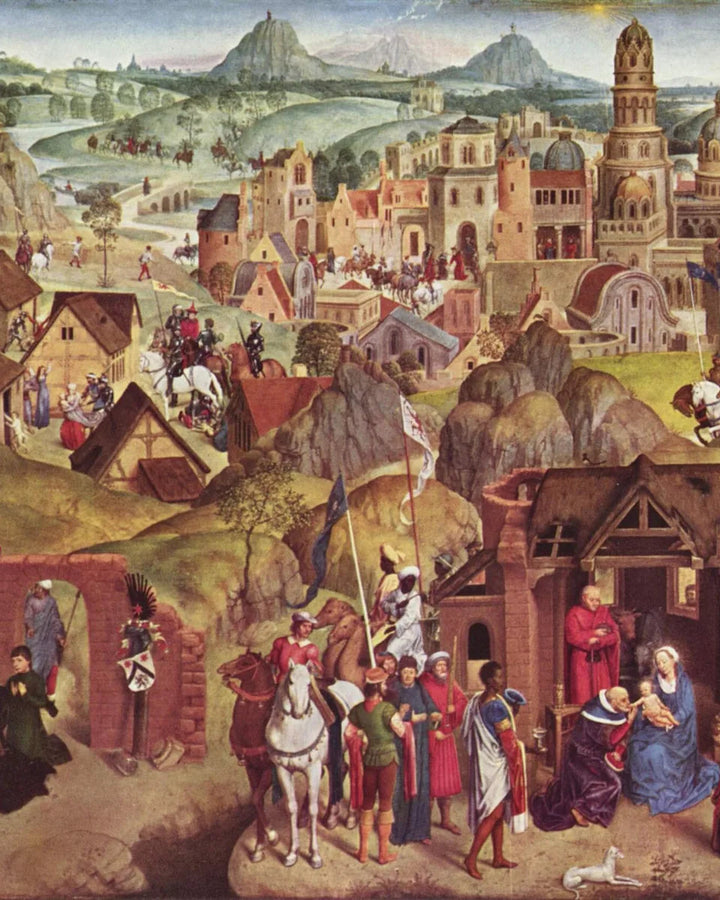
Gold, frankincense and myrrh: what the wise men's gifts meant
What the wise men's three gifts were, what Matthew 2 says in the King James words, where gold, frankincense and myrrh appear elsewhere in Scripture, and what the church has read in them since the second century.

In this article
The wise men did not come empty-handed. Matthew says that when they found the young child with Mary his mother, they knelt, opened their treasures and gave him gold, frankincense and myrrh: a precious metal and two fragrant tree resins, each costly, each carried a long way.
Gold was the gift owed to a king. Frankincense was burned as incense in the worship of God. Myrrh was used to anoint and to prepare the dead for burial. Since the second century, Christians have read the three together as a sign of who the child was: a king, God with us, and one who would die.
What does the Bible say about the wise men's gifts?
The Bible tells of the wise men's gifts in one verse, Matthew 2:11. It reads: "And when they were come into the house, they saw the young child with Mary his mother, and fell down, and worshipped him: and when they had opened their treasures, they presented unto him gifts; gold, and frankincense, and myrrh" (Matthew 2:11, KJV).
Read closely, the verse says less than the Christmas card. Matthew never says there were three wise men, only three kinds of gift. He does not call them kings or give their names; Caspar, Melchior and Balthasar come from later Western tradition.
And they come "into the house" to find "the young child", which is why so many readers place the visit some time after the birth. You can follow where it falls in the whole Christmas story told in order.
What were the wise men's three gifts?
The wise men's three gifts were gold, the metal of kings, and two aromatic tree resins, frankincense and myrrh, prized for worship, perfume and burial. All three came from far away and cost a great deal.
Gold
Gold was the wealth of kings and the tribute paid to them. In the Old Testament it lines the ark and the temple, and Psalm 72, a psalm for the king, looks for a day when "to him shall be given of the gold of Sheba" (Psalm 72:15, KJV). A gift of gold said plainly: we have come to a king.
Frankincense
Frankincense is a pale, milky resin that seeps from cuts in the bark of Boswellia trees, which grow in southern Arabia and the Horn of Africa. Burned, it gives off a sweet, resinous smoke. In the law of Moses it was part of the holy incense, "sweet spices with pure frankincense: of each shall there be a like weight" (Exodus 30:34, KJV), offered to God alone.
Myrrh
Myrrh is a darker, reddish resin from the thorny Commiphora tree of the same lands. It smells warm and bitter, and the Hebrew word for it is usually linked to bitterness. It went into the holy anointing oil, "of pure myrrh five hundred shekels" (Exodus 30:23, KJV), into perfumes, and into the spices wrapped with the dead.
What do gold, frankincense and myrrh mean?
Gold, frankincense and myrrh are most often read as three titles of Christ: gold for a king, frankincense for God, myrrh for a man who would die. Matthew does not explain the gifts himself, so this is a reading, not the text. It is, though, a very old one.
Around the year 180, Irenaeus of Lyon wrote that the wise men showed "who it was that was worshipped": myrrh "because it was He who should die and be buried", gold "because He was a King", and frankincense "because He was God". You can read the passage in Irenaeus, Against Heresies 3.9.
Some seventy years later Origen gave the same three, "gold, viz., as to a king; myrrh, as to one who was mortal; and incense, as to a God", in Origen, Against Celsus 1.60.
So the meaning did not begin with "We Three Kings", the carol that gives each gift a verse of its own. The carol inherited it. Later preachers built on it. Some read the gifts as Christ's three offices of king, priest and prophet; medieval sermons turned them into gifts any believer can bring: wisdom, prayer and self-denial. Both are devotional readings, held loosely.
Where else do the gifts appear in the Bible?
Gold, frankincense and myrrh appear across the Old Testament long before Matthew, and once again at the end of Jesus' life. Seen together, they show why these three were the gifts of worship.
| Gift | Where it appears (KJV) | What it shows |
|---|---|---|
| Gold | Psalm 72:10-11, 15 | Kings of Sheba bring gifts to the king; "the gold of Sheba" |
| Gold and incense | Isaiah 60:6 | "all they from Sheba shall come: they shall bring gold and incense" |
| Frankincense | Exodus 30:34; Leviticus 2:1 | Part of the holy incense and laid on the "meat offering" of flour |
| Myrrh | Exodus 30:23 | The first spice of the holy anointing oil |
| Myrrh and frankincense | Song of Solomon 3:6 | The perfume of a royal procession |
| All three | Matthew 2:11 | The wise men's gifts to the young child |
| Myrrh | Mark 15:23 | Wine mingled with myrrh, offered at the cross and refused |
| Myrrh | John 19:39 | Nicodemus brings myrrh and aloes for the burial |
In the King James text, Isaiah 60:6 reads "gold and incense"; the Hebrew word there is the one the same translators render "frankincense" in Exodus 30:34, so modern versions that say "gold and frankincense" are translating the same word. Isaiah names two of Matthew's three gifts, and Christians have long heard the prophecy in the wise men's visit.
Why did Jesus refuse myrrh on the cross?
Jesus refused the myrrh because it was offered as a drink to dull the pain of crucifixion. Mark writes: "And they gave him to drink wine mingled with myrrh: but he received it not" (Mark 15:23, KJV). Many readers take the refusal to mean he chose to bear the cross with a clear mind.
Myrrh comes back once more after his death. Nicodemus "brought a mixture of myrrh and aloes, about an hundred pound weight" (John 19:39, KJV) to wrap the body. The gift brought to a child in a house in Bethlehem returns at his tomb, which is why Irenaeus read it as a sign of burial. The life of Jesus told in order, to the burial shows how far that arc runs.
How valuable were the wise men's gifts?
The wise men's gifts were all costly, but Matthew gives no amounts, so no one knows what they were worth. Frankincense and myrrh were carried by caravan from southern Arabia, and that long road made them luxuries in Jerusalem and Rome alike.
In the ancient world, gifts like these were what one brought to a king or offered at a temple. Psalm 72 pictures kings bringing presents and "the gold of Sheba" to the king (Psalm 72:10, 15, KJV); the wise men gave in that spirit.
What did Mary and Joseph do with the gifts?
The Bible does not say what Mary and Joseph did with the gold, frankincense and myrrh. Matthew moves straight from the gifts to the angel's warning and the flight into Egypt (Matthew 2:13). The idea that the gold paid for the flight into Egypt is a reasonable guess, and it is only a guess.
When Mary was purified after the birth, the family offered "a pair of turtledoves, or two young pigeons" (Luke 2:24, KJV), the offering the law allowed for those "not able to bring a lamb" (Leviticus 12:8, KJV). Many readers take this to mean the family was poor at the time, so the wise men, and their gold, had not yet come.
How have painters shown the three gifts?
Painters have usually shown the gifts as the most precious objects of their own day. In Andrea Mantegna's Adoration of the Magi, painted about 1500 and now at the Getty, the oldest king offers a rare Chinese porcelain cup filled with gold coins, the younger holds a Turkish censer for the incense, and the third carries a covered cup of agate.
Mantegna pressed the six figures close to us, as if the viewer kneels with them. Look at the cup: the gold is half hidden, and the child raises a hand in blessing. Many painters put the kings at the manger with the ox and ass, mixing Luke and Matthew. For the wider story of how painters have shown the Nativity scene, from Giotto to Correggio, the pillar page has the paintings side by side.
When are the wise men's gifts remembered?
The wise men's gifts are remembered at Epiphany, on January 6, when the twelve days of Christmas end. Reading Matthew 2:1-12 aloud that evening takes about three minutes, and it fits beside the Christmas Bible verses in the King James words you may already read in December. The church calendar from Advent onward explains how the seasons connect.
The CHRIST book, Mercy & Light's art book of the life of Jesus, opens with the Nativity in the words of Luke and Matthew, with art made for each scene and the King James text set beside it. Its wise men kneel in a house beneath the star, as Matthew tells it. It sits with the rest of our art books of the life of Jesus.
If you are choosing something for Christmas with the wise men in mind, our Christian Christmas gift ideas that carry meaning start from the same question they did: what is worth bringing?
Frequently asked
What is the Bible verse about gold, frankincense and myrrh?
The verse is Matthew 2:11, where the wise men "presented unto him gifts; gold, and frankincense, and myrrh" (Matthew 2:11, KJV). It is the only verse that names all three together. Psalm 72 speaks of kings bringing gifts and "the gold of Sheba", and Isaiah 60:6 of those from Sheba bringing "gold and incense".
How do frankincense and myrrh smell?
Frankincense smells sweet, clean and resinous when burned, close to pine and citrus. Myrrh is warmer, earthier and bitter. Both are still sold as resin and oil, so you can smell them for yourself.
Were there three wise men?
Matthew does not say how many wise men came. The number three is inferred from the three gifts. Their names and the idea that they were kings were added by later tradition.
Did the wise men visit Jesus at the manger?
No. Matthew says the wise men came "into the house" and found "the young child" (Matthew 2:11, KJV). The shepherds came to the manger on the night of the birth; the wise men came later.
What do the three gifts of the Magi represent?
The three gifts of the Magi are usually read as gold for a king, frankincense for God and myrrh for a death to come. Irenaeus and Origen wrote this reading down in the second and third centuries. Matthew records the gifts without explaining them.
Passages cited: Matthew 2:11 (quoted); Matthew 2:1-12; Matthew 2:13; Psalm 72:10-11, 15 (quoted: 72:15); Isaiah 60:6 (quoted); Exodus 30:23 (quoted); Exodus 30:34 (quoted); Leviticus 2:1; Song of Solomon 3:6; Mark 15:23 (quoted); John 19:39 (quoted); Luke 2:24 (quoted); Leviticus 12:8 (quoted).

Mercy & Light
Mercy & Light makes art and books of Scripture for the home, crafted with care and made to be kept for a lifetime. Every article names the passage it rests on, and every reference is checked against the text before it is published. About us