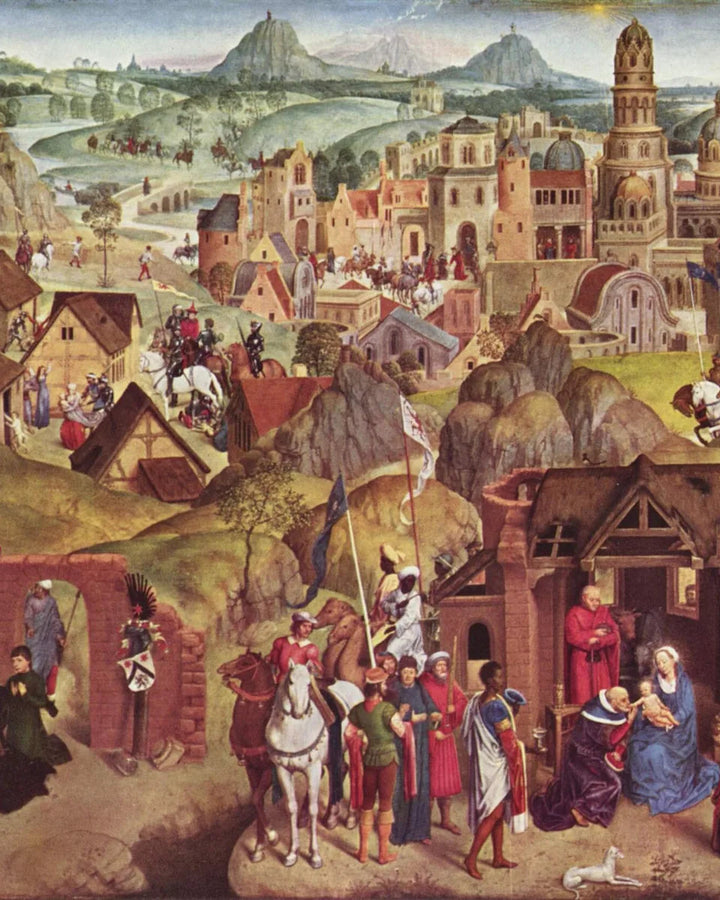
Keeping Christ in Christmas: traditions for home
How to keep Christ at the centre of Christmas at home, tradition by tradition from Advent to Epiphany, with the King James passage behind each one, a Christmas Eve reading order and a Nativity scene set up the way Scripture tells it.

In this article
Keeping Christ in Christmas means letting the story of His birth set the shape of the season at home: candles through Advent, Luke 2 read aloud on Christmas Eve, and the wise men arriving at Epiphany. Each of those traditions rests on a passage of Scripture you can read together, and the tree and the presents can stay.
What makes them last is repetition: the same candle, the same chapter, the same table, every December.
How do you keep Christ in Christmas at home?
You keep Christ in Christmas at home by tying the season's familiar moments to the Gospel story: an Advent wreath lit on Sundays, the Nativity read aloud on Christmas Eve, the crèche set up in the order Scripture tells it, a prayer at the Christmas table and gifts that point back to the first gift. The traditions stay, and the story moves to the middle.
Here is the whole season on one page.
| Moment | Tradition | The Scripture behind it |
|---|---|---|
| Four Sundays of Advent | Light the Advent wreath, one more candle each week | "have seen a great light" (Isaiah 9:2) |
| Through December | A short daily reading, in story order | "thou shalt call his name JESUS" (Matthew 1:21) |
| Christmas Eve | Read the birth of Jesus aloud, shepherds and all | "laid him in a manger" (Luke 2:7) |
| Christmas morning | Pray before the presents, then open them | "Thanks be unto God for his unspeakable gift" (2 Corinthians 9:15) |
| Christmas dinner | Give thanks with the angels' words | "Glory to God in the highest" (Luke 2:14) |
| The twelve days | Leave the scene up; move the wise men closer each day | "they rejoiced with exceeding great joy" (Matthew 2:10) |
| Epiphany, January 6 | The wise men reach the house and offer their gifts | "they presented unto him gifts" (Matthew 2:11) |
You do not need all of it. Pick two, keep them every year, and add one when the children are ready.
How do you celebrate Advent at home?
You celebrate Advent at home by keeping the four weeks before Christmas as a season of waiting. The simplest way to keep it is an Advent wreath on the dinner table, with one more candle lit each Sunday and a short passage read aloud. It turns the countdown to presents into a countdown to Christ.
The first candle goes with Isaiah: "The people that walked in darkness have seen a great light" (Isaiah 9:2, KJV). Our guide to the Advent wreath's four candles and what each means gives the reading for every Sunday and the order to light them in.
If you want something for each evening, not only Sundays, our Advent Bible reading plan, with a passage for every day walks through Luke 1 and Matthew 1 so the story arrives at Bethlehem on Christmas Eve. And if you have never kept the season before, start with what Advent is and why it looks to two comings.
What should a family read on Christmas Eve?
A Christmas Eve reading for the family can be five short passages, read by different people, in about fifteen minutes. Start with the prophecy, move to the birth and the shepherds, and end with John's first chapter. Turn the lights down, light the white candle if you have a wreath, and let the youngest reader go first.
- Isaiah 9:6, the promise. "For unto us a child is born, unto us a son is given" (Isaiah 9:6, KJV). Isaiah speaks to a frightened kingdom about a king who will come.
- Luke 2:1-7, the birth. Caesar's decree, the road to Bethlehem, and the manger: "and laid him in a manger; because there was no room for them in the inn" (Luke 2:7, KJV).
- Luke 2:8-14, the shepherds and the angels. It happens at night: "shepherds abiding in the field, keeping watch over their flock by night" (Luke 2:8, KJV). Let the whole family say verse 14 together.
- Luke 2:15-20, the visit. The shepherds go, find the child, and tell everyone. "But Mary kept all these things, and pondered them in her heart" (Luke 2:19, KJV).
- John 1:14, what it means. "And the Word was made flesh, and dwelt among us" (John 1:14, KJV). John tells no birth story; he says who was born.
Leave the wise men for later. They belong to Epiphany, and the next section explains why. For every Christmas passage in the King James words, with who is speaking and why, see our collection of Christmas Bible verses in the King James Version.
How should you set up a Nativity scene?
A Nativity scene set up in the order of the Gospels fills in over several weeks. The stable and the animals go out first (Luke names only the manger; the ox and donkey are old tradition), Mary and Joseph arrive on Christmas Eve, the infant is placed in the manger that night with the shepherds beside Him, and the wise men travel across the room until they arrive on January 6, Epiphany.
The reason is in Matthew. The wise men come later, and they find the family somewhere else: "And when they were come into the house, they saw the young child with Mary his mother, and fell down, and worshipped him" (Matthew 2:11, KJV). Matthew speaks of a house and a young child. Herod's order to kill the boys "from two years old and under" (Matthew 2:16, KJV) suggests some time had passed.
A crèche with everyone at the manger at once is a lovely picture of the whole world coming to Christ. Staging it in order lets children see the story move:
- Advent: the empty stable, the ox and the donkey. Mary and Joseph start in another room and move a little closer each week.
- Christmas Eve: Mary and Joseph reach the stable. The infant goes in the manger after the reading, and the shepherds and angel arrive with Him.
- The twelve days: the wise men begin on the far side of the room and move a step each day.
- Epiphany: the wise men arrive. Some families move the Holy Family to a little house of blocks for the visit, as Matthew has it.
The custom of the crèche itself is old. The Catholic Encyclopedia's entry on Christmas credits St. Francis of Assisi, at Greccio in 1223, with the Nativity scene as it is kept today. Painters show the same scenes; our guide to famous Nativity paintings and the Scripture behind them looks at how Giotto, Botticelli and others painted the shepherds and the kings.
How do you make Christmas morning about Jesus?
You make Christmas morning about Jesus by praying before the presents are opened and by giving gifts that point back to God's gift. A one-line grace is enough: "Thanks be unto God for his unspeakable gift" (2 Corinthians 9:15, KJV). Paul closes a chapter on generosity with it, and many readers take that gift to be Christ.
At the Christmas dinner table, give thanks with the angels' words, said together: "Glory to God in the highest, and on earth peace, good will toward men" (Luke 2:14, KJV). Some families leave an empty chair or set aside a portion of the meal for a neighbour who is alone, and take it round after.
A Bible with a name written inside, a hymnal or a handwritten verse all say what the day is for. Our Christian Christmas gift ideas for the people you love has more, and our own pieces are in Christian Christmas gifts from Mercy & Light.
A book that tells the whole story helps when the readings run out. CHRIST, Mercy & Light's art book of the life of Jesus opens with the Nativity in its first chapter, God With Us, in the words of Matthew and Luke, and goes on through His life, with art made for each scene and the King James text beside it. Left out on the coffee table through December, it is a book a child opens alone.
What are the twelve days of Christmas?
The twelve days of Christmas run from December 25 to January 5, and Epiphany follows on January 6, the day Western churches remember the wise men's visit. Keeping both stretches the season past the wrapping paper and gives the wise men their arrival, so Christmas ends with the nations coming to Christ.
The twelve days are old; the church called them holy in the sixth century.
Simple ways to keep them at home:
- Leave the decorations up until Epiphany, and the Nativity scene with them.
- Read a verse of Matthew 2 each evening as the wise men move closer: "When they saw the star, they rejoiced with exceeding great joy" (Matthew 2:10, KJV).
- Save one small gift for each child on January 6, the gift the wise men bring.
- Bless the door. Many families chalk the year and a cross above the front door on Epiphany, an old custom of asking God's blessing on the home for the year ahead.
For the room itself, our ideas for religious Christmas decorations that keep Christ in the room cover the mantel, the table and the children's rooms.
Where does the saying come from?
The saying "Keep Christ in Christmas" leans on the name of the feast itself. According to the Catholic Encyclopedia's entry on Christmas, the late Old English word was Cristes Maesse, the Mass of Christ, first found in 1038. The worry that the feast could lose its centre is just as old as its customs, and it has gone both ways.
The same entry records the Second Council of Tours, in 566 or 567, proclaiming the twelve days from Christmas to Epiphany holy. It also records that Parliament suppressed Christmas in 1640s England: the day was to be a fast and a market day, and shops were compelled to open.
Today the question is quieter. A Pew Research Center survey from 2017 found that 55% of U.S. adults celebrate Christmas as a religious holiday. At home the answer is simple: what we read, light and pray on the days we already keep.
Does the Bible say anything about celebrating Christmas?
The Bible does not command a Christmas feast or give the date of Jesus' birth, and the word Christmas is not in Scripture. What the Bible gives is the event itself, told in Matthew and Luke, and the joy that greeted it. The angels, the shepherds and the wise men all celebrate the birth, each in their own way.
Paul's word on holy days fits the question: "One man esteemeth one day above another: another esteemeth every day alike. Let every man be fully persuaded in his own mind" (Romans 14:5, KJV). Christians who keep Christmas do it, in Paul's next words, "unto the Lord" (Romans 14:6, KJV). The shepherds set the pattern: they "returned, glorifying and praising God for all the things that they had heard and seen" (Luke 2:20, KJV).
To place the birth in the whole of His life, our timeline of the life of Christ, the story of Jesus in order begins at Bethlehem and goes on to the empty tomb.
Frequently asked
What are some Christ-centered Christmas traditions?
The most common Christ-centered Christmas traditions are an Advent wreath lit each Sunday, a daily Advent reading, Luke 2 read aloud on Christmas Eve, a Nativity scene, a prayer before presents, and keeping the twelve days through Epiphany. Choose two or three and keep them every year; repetition is what makes them last.
How do you make Christmas about Jesus with young children?
To make Christmas about Jesus with young children, give them something to do with the story. Let them move Mary and Joseph closer each week, place the infant in the manger after the Christmas Eve reading, and walk the wise men across the room until Epiphany. A picture book or an illustrated life of Jesus helps them follow along.
When should the wise men go in the Nativity scene?
The wise men go in the Nativity scene on January 6, Epiphany, if you follow Matthew's order. Matthew says they found "the young child" in "the house" (Matthew 2:11, KJV), some time after the birth. Many families set them on the far side of the room on Christmas Day and move them a little closer each evening.
Whatever you keep this year, keep it at the same table next year. The story does the rest.
Passages cited: Isaiah 9:2; Micah 5:2; Luke 1; Matthew 1; Matthew 1:21; Luke 2:1-20; 2 Corinthians 9:15; Luke 2:14; Matthew 2:1-11; Isaiah 9:6; Luke 2:7; Luke 2:8; Luke 2:19; John 1:14; Matthew 2:16; Matthew 2:10; Romans 14:5-6; Luke 2:20.

Mercy & Light
Mercy & Light makes art and books of Scripture for the home, crafted with care and made to be kept for a lifetime. Every article names the passage it rests on, and every reference is checked against the text before it is published. About us