Christmas Bible verses in the KJV, for cards and the season
The Christmas verses people reach for, in the exact King James words, with card-length cuts, what to write beside them in a card or a gift book, and where the KJV reads differently from modern Bibles.
En este artículo
The Christmas Bible verses most people reach for are Luke 2:10-14, the angel's news to the shepherds, along with Isaiah 9:6, Matthew 1:21-23 and John 1:14. Below, each one is given in the King James Version, word for word, with who said it and why it matters.
This is Christmas scripture in the words Handel set to music in Messiah. The verses below are grouped by use: for cards, for a book you give, for children and for someone having a hard year.
What are the best Christmas Bible verses?
The best Christmas Bible verses tell the story itself: Isaiah 9:6 for the promised child, Matthew 1:23 for "God with us", Luke 2:10-11 for the announcement, Luke 2:14 for the angels' praise and John 1:14 for what Christmas means. Here they are in the order the story happens, each with who is speaking and why it matters.
Isaiah 9:6, the promise. "For unto us a child is born, unto us a son is given: and the government shall be upon his shoulder: and his name shall be called Wonderful, Counsellor, The mighty God, The everlasting Father, The Prince of Peace" (Isaiah 9:6, KJV). The prophet Isaiah wrote this centuries before Bethlehem, to a frightened nation, promising a king who would bring lasting peace. Christians have always read it as the first portrait of Jesus. For a card, the opening line is enough.
Micah 5:2, the place. "But thou, Bethlehem Ephratah, though thou be little among the thousands of Judah, yet out of thee shall he come forth unto me that is to be ruler in Israel" (Micah 5:2, KJV). Micah names a small town as the birthplace of the coming ruler. In Matthew, the chief priests quote this line when King Herod asks where the Christ would be born.
Matthew 1:21, the name. "Thou shalt call his name JESUS: for he shall save his people from their sins" (Matthew 1:21, KJV). An angel says this to Joseph in a dream, while he is deciding whether to quietly break off his engagement to Mary. The name itself is the message: it comes from the Hebrew for "the Lord saves".
Matthew 1:23, God with us. "They shall call his name Emmanuel, which being interpreted is, God with us" (Matthew 1:23, KJV). Matthew is quoting Isaiah 7:14 and translating the Hebrew name for his readers. It is the shortest statement of what Christmas claims: that God came to live among us.
Luke 2:10-11, the announcement. "Fear not: for, behold, I bring you good tidings of great joy, which shall be to all people. For unto you is born this day in the city of David a Saviour, which is Christ the Lord" (Luke 2:10-11, KJV). An angel speaks these words to shepherds keeping watch over their flocks at night, outside Bethlehem. The first people to hear the news were workers on a night shift.
Luke 2:14, the angels' praise. "Glory to God in the highest, and on earth peace, good will toward men" (Luke 2:14, KJV). As soon as the angel finishes, a crowd of angels fills the sky praising God. It fits a card whole.
Matthew 2:10, the star. "When they saw the star, they rejoiced with exceeding great joy" (Matthew 2:10, KJV). The wise men have come from the east following a star; here it stops over the house where the child is, and they know they have arrived. The next verse names the three gifts the wise men brought and their meaning.
John 1:14, the meaning. "And the Word was made flesh, and dwelt among us... full of grace and truth" (John 1:14, KJV). John tells no birth story at all. He opens with "the Word", God's own self-expression, and this verse is his Christmas: God became a human being and lived among people.
What is the most common Christmas verse?
The most common Christmas verse is Luke 2:11, read as part of Luke 2:10-14. When Lifeway Research looked at five years of reading data from the YouVersion Bible app, it found that the most popular Bible verses during the Christmas season were Luke 2:11-14, ahead of Matthew 1:21 and Isaiah 9:6.
It is easy to see why. In one line, "For unto you is born this day in the city of David a Saviour, which is Christ the Lord" (Luke 2:11, KJV) tells you who was born, where, when and why it matters.
For the whole account around it in order, read the Gospels' story of the life of Christ from Bethlehem onward, or take it slowly with our Advent reading plan, the Christmas story week by week.
Which Bible verses are good for a Christmas card?
The best Bible verses for a Christmas card are short enough to read in one breath and need no explanation: Luke 2:11, Luke 2:14, Matthew 1:23, Isaiah 9:6 and John 1:14. Choose by the person. Luke 2:14 suits almost anyone; John 1:14 suits a reader who loves to think about what it all means.
For a card that goes to many people, print one verse in every card, then write a different line by hand underneath. People notice the handwriting first.
Some verses suit particular people well:
- For family: "Glory to God in the highest, and on earth peace, good will toward men" (Luke 2:14, KJV). The angels' blessing, wished over everyone at the table.
- For a new parent: "For unto us a child is born, unto us a son is given" (Isaiah 9:6, KJV). Words about one birth that every new parent understands.
- For someone far away: "Emmanuel, which being interpreted is, God with us" (Matthew 1:23, KJV). A reminder that distance does not leave anyone alone.
- For a pastor or teacher: "The Word was made flesh, and dwelt among us... full of grace and truth" (John 1:14, KJV). The verse for someone who spends their life explaining the Word.
- For a friend who gives freely: "Thanks be unto God for his unspeakable gift" (2 Corinthians 9:15, KJV). Paul's thanks for God's gift, which many readers take to mean Christ himself.
What do you write in a Christmas card with a verse?
Write one or two plain sentences that connect the verse to the person: why you chose it, or what you hope for them this year. Keep it short, keep it warm, and sign with your name. The verse carries the weight; your line makes it theirs.
Lines to adapt:
- "We chose Luke 2:14 for you this year. Peace on earth starts at our tables, and we are glad you are at ours."
- "'God with us' has meant more this year than it used to. Thinking of you, with love."
- "Unto us a child is born. Watching the children open their gifts, I thought of the Christmas when you first held yours."
If you are writing to someone who does not share your faith, a verse can still be a kindness, if it is offered as yours and not as a lesson. Luke 2:14 is the gentlest choice: peace and good will, with nothing asked of them.
What should you write in a book you give at Christmas?
In a book given at Christmas, write the person's name, a verse, a line from you and the date, on the first blank page or the dedication page. An inscription is read for years, so write it slowly and say something true about the person. Here, a verse can do what a card cannot: travel with the book.
Inscriptions to adapt:
- "For Grace, this first Christmas in the new house. 'But Mary kept all these things, and pondered them in her heart' (Luke 2:19, KJV). With all our love."
- "To Dad, who read Luke 2 to us every Christmas Eve. Your turn to listen. 'Glory to God in the highest' (Luke 2:14, KJV)."
- "For Sam and Ellie, to open together. 'For unto us a child is born' (Isaiah 9:6, KJV). From Grandma and Grandpa, Christmas" and the year.
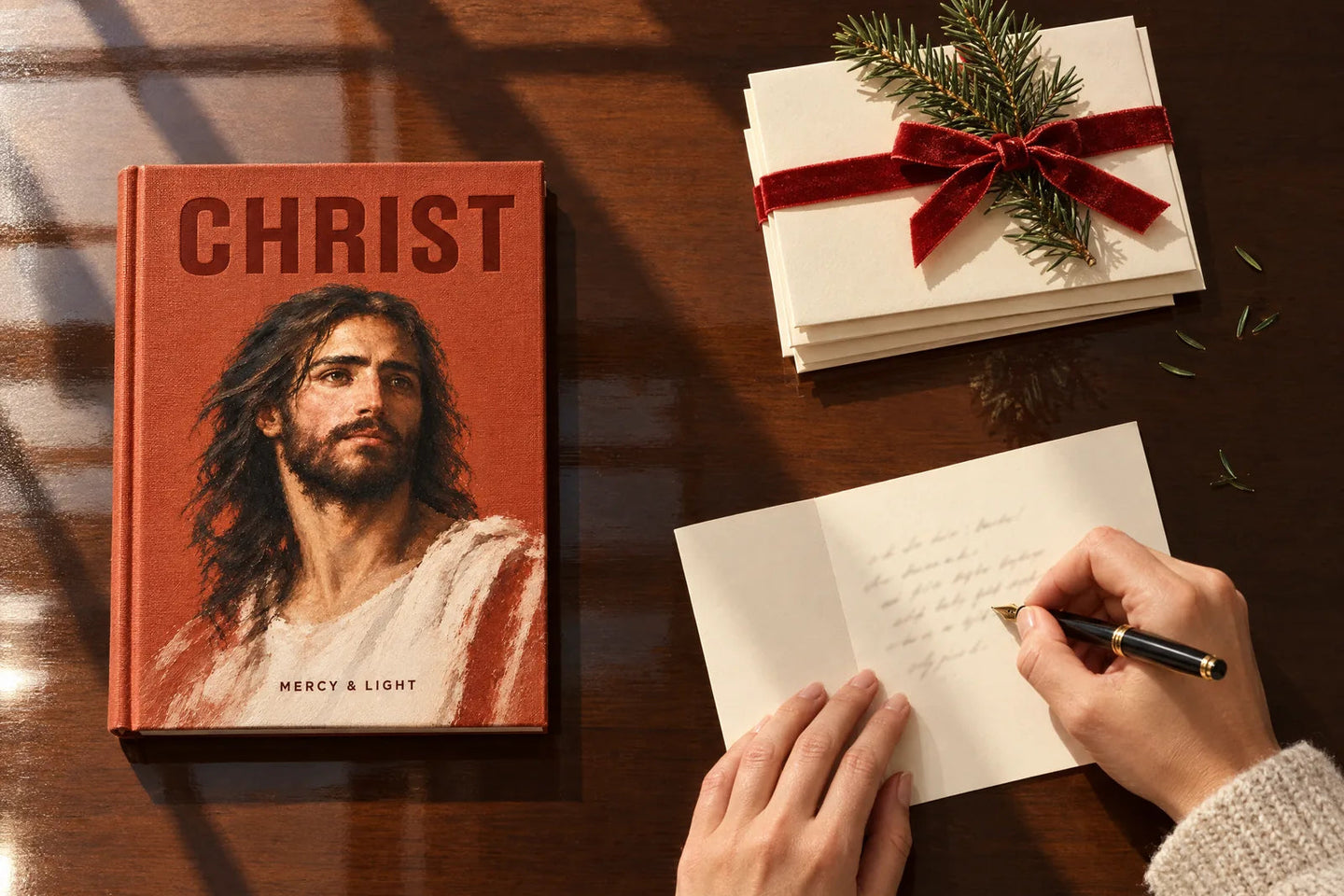
CHRIST, Mercy & Light's art book of the life of Jesus, has a dedication page at the front made for exactly this. Its first chapter is the Nativity, told in the words of Luke and Matthew, with art made for each scene and the King James text set beside it.
Which verses speak of peace, joy, light and love?
The Christmas verses about peace, joy, light and love fall into four groups: peace (Luke 2:14, Isaiah 9:6), joy (Luke 2:10, Matthew 2:10), light (Isaiah 9:2, John 1:5) and love (John 3:16, 1 John 4:9). Painters gave each theme a shape you can still see in the great Nativity pictures.
The same four words name the Sundays of Advent in many churches, a twentieth-century custom; our guide to what Advent is and where its themes came from sets out which parts are Scripture and which are tradition.
Peace. "On earth peace, good will toward men" (Luke 2:14, KJV). In Botticelli's Mystic Nativity, the angels circling the sky carry olive branches, a symbol of peace, and in the foreground angels embrace men.
Joy. "When they saw the star, they rejoiced with exceeding great joy" (Matthew 2:10, KJV). Giotto painted that star as a blazing comet in his Adoration of the Magi in Padua. He is thought to have seen Halley's Comet in 1301, and the European probe that flew past the comet in 1986 was named after him.
Light. "The people that walked in darkness have seen a great light" (Isaiah 9:2, KJV), and "the light shineth in darkness; and the darkness comprehended it not" (John 1:5, KJV). Geertgen tot Sint Jans painted his Nativity at Night almost entirely dark, with the light coming from the child.
Love. "For God so loved the world, that he gave his only begotten Son" (John 3:16, KJV). Correggio's Holy Night can be read the same way: Mary bending over her son, her face lit by him.

The story behind these pictures, and what each painter added to Luke and Matthew, is in our guide to famous Nativity paintings and the story they tell. If you would rather hang a verse than a scene, our note on choosing between Bible verse art and scene art may help.
Which short verses suit children at Christmas?
Short Christmas verses for children are the ones they can picture: the baby in the manger (Luke 2:12), the star (Matthew 2:10) and the angel saying "Fear not" (Luke 2:10). Read the verse, then ask the child to find that part in a Nativity scene.
- "Ye shall find the babe wrapped in swaddling clothes, lying in a manger" (Luke 2:12, KJV). The angel tells the shepherds how they will know the right baby: wrapped up snug, in an animals' feeding box.
- "When they saw the star, they rejoiced with exceeding great joy" (Matthew 2:10, KJV). The wise men see the star stop, and they are so happy they can hardly contain it.
- "Fear not: for, behold, I bring you good tidings of great joy" (Luke 2:10, KJV). The first thing the angel says to the frightened shepherds is: don't be scared, this is good news.
- "For with God nothing shall be impossible" (Luke 1:37, KJV). The angel Gabriel says this to Mary, after telling her she will have a baby.
Children love "swaddling clothes" and "good tidings" once they know what they mean, and the old words stay with them. For what the Gospels say about the years that followed, see what Scripture tells of Jesus' childhood.
What verses comfort someone at a hard Christmas?
For a hard Christmas, after a death, an illness or a lonely year, choose the verses that promise light in the dark over the ones that call for celebration. Isaiah 9:2, Luke 1:78-79 and Psalm 34:18 say what a grieving reader needs to hear without asking them to feel festive.
- "The people that walked in darkness have seen a great light" (Isaiah 9:2, KJV). Isaiah wrote it for a land in its darkest days, a few lines before "unto us a child is born".
- "To give light to them that sit in darkness and in the shadow of death, to guide our feet into the way of peace" (Luke 1:79, KJV). Zacharias sings this over his newborn son, John the Baptist, about the Saviour soon to come.
- "The LORD is nigh unto them that are of a broken heart" (Psalm 34:18, KJV). A psalm of David, for anyone who cannot feel the joy this year.
- "Come unto me, all ye that labour and are heavy laden, and I will give you rest" (Matthew 11:28, KJV). The grown Jesus' own invitation, for when the season feels too heavy.
In the card, say less than you think you should. "Thinking of you this Christmas, and missing them with you" says more than a paragraph.
Where does the KJV read differently from modern Bibles?
The King James Version reads differently from most modern Bibles in a few well-known Christmas verses, mainly Luke 2:14 and Isaiah 9:6. The table shows where, so the words in your card match the Bible your reader knows, and so a carol, a card and a Bible on the same table do not seem to disagree.
| Verse | In the King James Version | What you may see elsewhere |
|---|---|---|
| Luke 2:14 | "on earth peace, good will toward men" | Many modern Bibles follow older Greek manuscripts and read it as peace to people God favors |
| Isaiah 9:6 | "Wonderful, Counsellor" with a comma, two names | "Wonderful Counselor" as one name |
| Isaiah 7:14 and Matthew 1:23 | "Immanuel" in Isaiah, "Emmanuel" in Matthew | Usually "Immanuel" in both |
| Luke 2:13 | The angels are "praising God, and saying" | Carols and cards say the angels sang; Luke does not |
| Matthew 2:1 | "wise men from the east", no number | "Three" is inferred from the three gifts (Matthew 2:11); "kings" is later tradition |
Handel's Messiah sets Isaiah 9:6 with the comma, which is why the chorus sings "Wonderful" and "Counsellor" as two separate cries. The words were drawn from Scripture by Charles Jennens, and the Foundling Museum holds a wordbook sold at the first performance, in Dublin in 1742.
Keeping the verses close this Christmas
You can find the CHRIST book with the other books we make in our books, in one place. If you are gathering gifts as well as cards, our Christian Christmas gift ideas that carry the story start from the same story, and our ideas for Christmas decorations that keep Christ in the room bring them into the house. For a Christmas Eve reading order built from these passages, see our guide to keeping Christ in Christmas at home. To read the verses in their places, from Gabriel to Egypt, see the Christmas story in the Bible, told in order.
Choose one verse, write it out by hand and put it where you will see it on the way to bed. By the end of December you will know it by heart.
Frequently asked
Is Luke 2:11 a Christmas verse?
Yes. Luke 2:11 is the angel's announcement of the birth of Jesus to the shepherds: "For unto you is born this day in the city of David a Saviour, which is Christ the Lord" (Luke 2:11, KJV). It is the moment in Scripture where the birth is announced, and the most read verse of the Christmas season.
Can I print King James verses on Christmas cards?
In the United States the King James Version is in the public domain, so you can print its verses on cards, gifts and decorations freely. In the United Kingdom the right to print the King James Bible is still held under the Crown's letters patent; a verse quoted in a personal card is ordinary quotation.
Did the angels sing in Luke 2?
Luke does not say the angels sang. He writes that "a multitude of the heavenly host" was "praising God, and saying, Glory to God in the highest" (Luke 2:13-14, KJV). Singing angels come from carols and paintings; the text says praising.
What is a good short Christmas verse?
Luke 2:14 is the best short Christmas verse for most uses: "Glory to God in the highest, and on earth peace, good will toward men" (Luke 2:14, KJV). For something shorter still, use "God with us" from Matthew 1:23 or "Unto us a child is born" from Isaiah 9:6.
Passages cited: Luke 1:37; Luke 1:78-79 (quoted: 1:79); Luke 2:10-14 (quoted: 2:10, 2:10-11, 2:11, 2:12, 2:13-14, 2:14); Luke 2:19; Isaiah 7:14; Isaiah 9:2; Isaiah 9:6; Micah 5:2; Matthew 1:21; Matthew 1:23; Matthew 2:1; Matthew 2:10; Matthew 2:11; John 1:5; John 1:14; John 3:16; 1 John 4:9; 2 Corinthians 9:15; Psalm 34:18; Matthew 11:28.

Mercy & Light
Mercy & Light crea arte y libros de la Escritura para el hogar, hechos con esmero y pensados para conservarse toda la vida. Cada artículo nombra el pasaje en el que se apoya, y cada referencia se comprueba contra el texto antes de publicarse. Sobre nosotros