Advent wreath meaning: the four candles, week by week
What the Advent wreath means, what each of its four candles and the white Christ candle stands for, the order to light them, the King James readings for each Sunday, and where the tradition really comes from.
En este artículo
By five o'clock in December it is dark, and one candle on the dinner table is the brightest thing in the room. That is the Advent wreath meaning: light growing in the dark, one more candle each Sunday until Christmas. The four candles stand for hope, peace, joy and love, three purple and one rose, and the white Christ candle in the centre is lit on Christmas Eve.
What is the meaning of the Advent wreath?
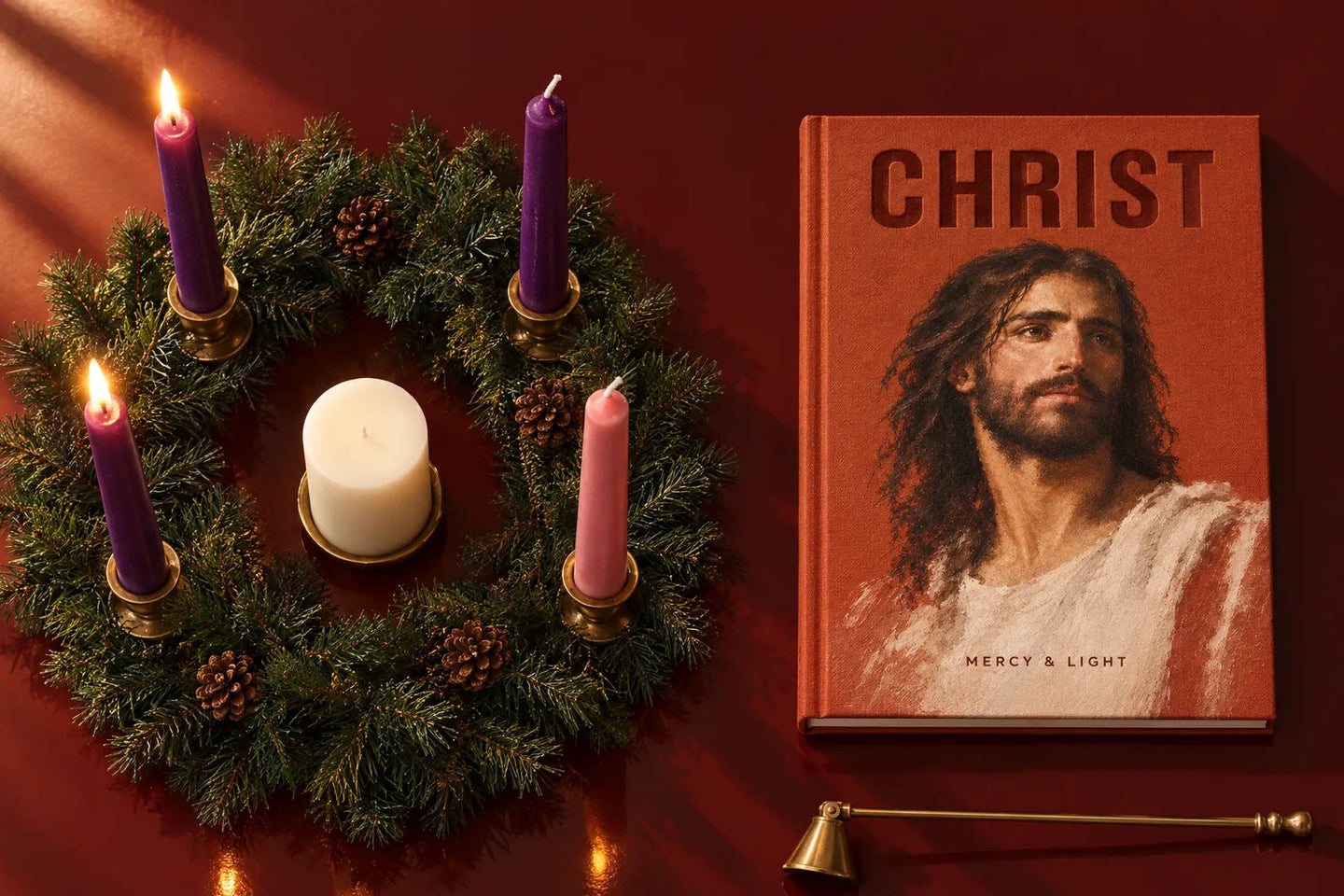
The Advent wreath is a ring of evergreen holding four candles, often with a fifth in the centre. The ring stands for God's love, with no beginning and no end; the evergreen for life that lasts through winter; and the candles for the light of Christ coming into a dark world, one Sunday at a time.
Each part carries one idea. Fir, pine or holly stays green when everything else looks dead. Pinecones, if you add them, are often read as new life.
The candles carry the real weight. The Vatican's Directory on Popular Piety and the Liturgy describes the wreath as "a symbol of the prophetic light gradually illuminating the long night", and points to two verses for that image.
The first is Malachi's promise: "But unto you that fear my name shall the Sun of righteousness arise with healing in his wings" (Malachi 4:2, KJV). It is the last prophet of the Old Testament speaking to a discouraged people. Catholic Bibles number the same verse Malachi 3:20.
The second is Zacharias, the father of John the Baptist, singing over his newborn son about the one who will come after him: "Through the tender mercy of our God; whereby the dayspring from on high hath visited us, To give light to them that sit in darkness and in the shadow of death, to guide our feet into the way of peace" (Luke 1:78-79, KJV).
When do you start the Advent wreath?
You light the first candle of the Advent wreath on the first Sunday of Advent, the fourth Sunday before Christmas, which in 2026 falls on November 29. For the season itself, why it looks to two comings of Christ and how it began, see our guide to what Advent is, its meaning, dates and history.
What do the four Advent candles mean?
The four Advent candles most often stand for hope, peace, joy and love, lit in that order over the four Sundays. Many churches also name them the Prophecy candle, the Bethlehem candle, the Shepherds' candle and the Angels' candle. Three are purple, the third is rose, and the white Christ candle is lit at Christmas.
| Sunday | Candle | Common theme | Traditional name | A King James reading |
|---|---|---|---|---|
| First | Purple | Hope | Prophecy | Isaiah 9:2 |
| Second | Purple | Peace | Bethlehem | Micah 5:2 |
| Third | Rose | Joy | Shepherds | Luke 2:10; Philippians 4:4 |
| Fourth | Purple | Love | Angels | Matthew 1:23; John 3:16 |
| Christmas Eve or Day | White, in the centre | Christ | Christ candle | John 8:12; Luke 2:11 |
First Sunday, hope. "The people that walked in darkness have seen a great light: they that dwell in the land of the shadow of death, upon them hath the light shined" (Isaiah 9:2, KJV). Isaiah wrote to a nation facing invasion, promising light before he names the child, which suits the name Prophecy candle.
Second Sunday, peace. "But thou, Bethlehem Ephratah, though thou be little among the thousands of Judah, yet out of thee shall he come forth unto me that is to be ruler in Israel" (Micah 5:2, KJV). Micah names a small town as the birthplace of a ruler. Centuries later, when Herod asks where the Christ would be born, the chief priests and scribes answer with this line (Matthew 2:5-6).
Third Sunday, joy. "Fear not: for, behold, I bring you good tidings of great joy, which shall be to all people" (Luke 2:10, KJV). An angel says this to shepherds watching their flocks at night outside Bethlehem, the scene the Shepherds' candle recalls.
Fourth Sunday, love. "Behold, a virgin shall be with child, and shall bring forth a son, and they shall call his name Emmanuel, which being interpreted is, God with us" (Matthew 1:23, KJV). Matthew sets this prophecy beside the angel's message to Joseph in a dream, the message the Angels' candle recalls. John gives the love behind it: "For God so loved the world, that he gave his only begotten Son" (John 3:16, KJV).
Christmas, the Christ candle. "I am the light of the world: he that followeth me shall not walk in darkness, but shall have the light of life" (John 8:12, KJV). Jesus says this of himself, years after Bethlehem. Lit on Christmas Eve, it is the light the other four were waiting for.
What does the Bible say about Advent?
The Bible never uses the word Advent, and the wreath and its candle names are not in Scripture. What Advent reads is in Scripture: the prophecies of a coming king in Isaiah, Micah and Malachi, and the birth narratives in Luke and Matthew. The season is the church's way of reading those passages in order before Christmas.
The candle themes are later still. Ask The UMC, from the United Methodist Church, says church supply houses assigned hope, love, joy and peace in the mid-twentieth century. The order still differs: some churches go hope, love, joy, peace, others hope, peace, joy, love.
Only the third Sunday is fixed nearly everywhere, because it is far older than the wreath: Gaudete, or "Rejoice", Sunday. A family that lights the candles with the passages above is standing on Scripture, whatever names it gives the flames.
In what order do you light the Advent candles?
You light one purple candle on the first Sunday of Advent, then that candle and a second purple one on the second Sunday. On the third Sunday you add the rose candle, and on the fourth the last purple. The white Christ candle in the centre is lit on Christmas Eve or Christmas Day.
- First Sunday: light one purple candle.
- Second Sunday: relight the first, then light a second purple candle.
- Third Sunday: relight both, then light the rose candle.
- Fourth Sunday: relight all three, then light the last purple candle.
- Christmas Eve or Day: light all four, then the white candle in the middle.
Which purple candle you start with does not matter; most people go around the ring so the rose falls third. Many families also relight the week's candles each evening at dinner.
Why are the Advent candles purple and pink?
The Advent candles are purple because purple is the church's colour for seasons of preparation and repentance, and it is also the colour of royalty, fitting for a coming king. The single pink, or rose, candle marks the third Sunday, Gaudete Sunday, when the mood turns from waiting to rejoicing because Christmas is near.
Gaudete comes from Paul's letter to the Philippians, written from prison to a church he loved: "Rejoice in the Lord alway: and again I say, Rejoice" (Philippians 4:4, KJV). The Latin of that verse opens the old service for the day, and the rose candle, like the rose vestments some priests wear, follows it.
Not every church uses the same colours:
- Blue is common in Lutheran and many Methodist churches, a colour of hope and of the night sky before dawn.
- Red candles are common in many British churches and homes.
- All white, or any colour at all, is fine at home. Ask The UMC notes that all colours are used in homes in Europe.
Who made the first Advent wreath?
The first Advent wreath was made in 1839 by Johann Hinrich Wichern, the Lutheran theologian who founded the Rauhes Haus in Hamburg. He set a large ring in the prayer hall of that home for poor children, with a candle for every day until Christmas Eve, so the children could count the days.
According to the Rauhes Haus, which still keeps the custom, the ring held large white candles for the Sundays and small red ones for the weekdays. The children of its school still gather around Wichern's wreath each morning of Advent.
Over the following decades the wreath slimmed to four Sunday candles set in evergreen. Protestant churches in Germany took it up first, Catholics followed in the twentieth century, and by the 1930s it had reached North America.
Is Advent only a Catholic thing?
Advent is not only a Catholic tradition. It is kept by Catholics, Lutherans, Anglicans and Episcopalians, Methodists, Presbyterians and many Baptist and non-denominational churches. The wreath itself began in a Lutheran children's home, and Orthodox Christians keep their own season before Christmas, the Nativity Fast.
At home it needs no church at all. A wreath, five candles and a Bible on the table are the whole of it.
Why is the Christ candle white and in the centre?
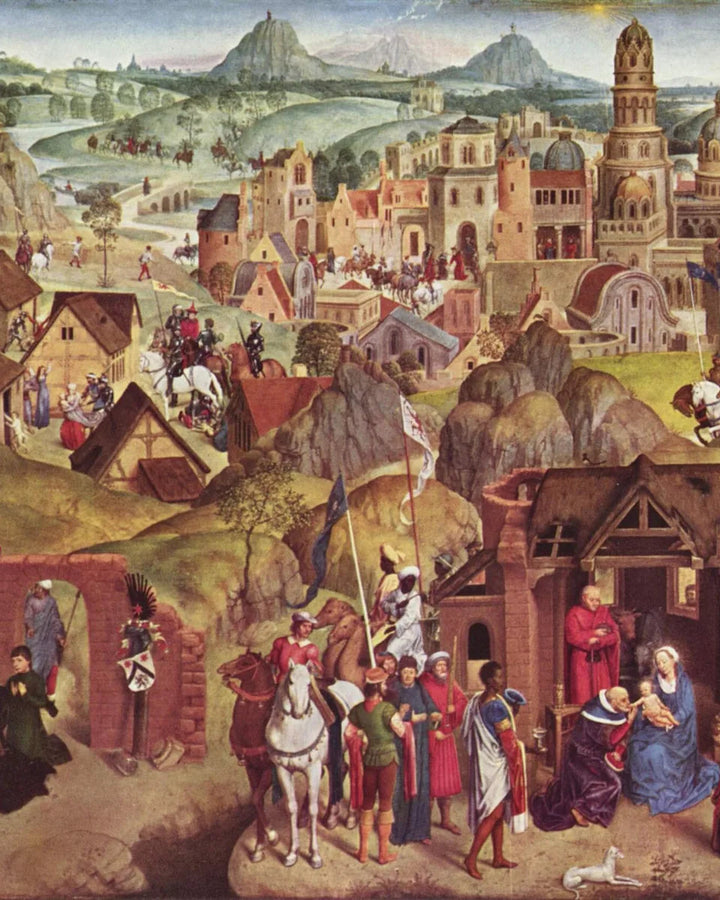
The Christ candle is white because white is the Western church's colour for its great feasts, Christmas and Easter. It stands in the centre because the whole wreath points to Christ, the light the other four candles wait for. Painters were showing that light centuries before the wreath existed, by making the child the light of the scene.

Geertgen tot Sint Jans' Nativity at Night is the clearest example: almost black, except where the infant shines on Mary's face and the angels around the manger. It is a fair picture of what the fifth candle means. We look at more of them in our guide to the famous Nativity paintings and the Scripture behind them.
Keeping an Advent wreath at home
An Advent wreath at home needs only a ring of greenery, four candles in holders and a fifth for the centre, set where the family eats. Each Sunday, light the candles, read the passage for that week aloud and pray briefly. It takes five minutes.
A few things make it easier:
- Fresh or faux greenery. Fresh fir smells wonderful but dries out; keep candles well clear of it and never leave the wreath lit in an empty room.
- One reader a week. Let a different person read each Sunday, starting with the youngest who can manage it.
- A missed week is fine. Light the candles you are up to and read both passages.
- Read the story, not only the verses. Our Christmas Bible verses in the King James words gives each passage with who is speaking and why, if you want more than one verse a week.
Some families read the whole birth narrative across the four weeks, from Luke 1 to the shepherds in Luke 2, so the Christ candle arrives at the end of the story. Our Advent Bible reading plan, with a passage for every day, sets that out week by week, and our guide to Christ-centred Christmas traditions from Christmas Eve to Epiphany carries the season on past the last candle. Our timeline of the life of Christ, the story of Jesus in order shows where each scene falls.
A book with pictures helps the youngest stay with it. CHRIST, Mercy & Light's art book of the life of Jesus, begins where Advent does, with light: a prologue that opens on John's "the light shineth in darkness" and Micah's Bethlehem, before its first chapter, God With Us, tells the Nativity in the words of Matthew and Luke. Each scene has art made for it, with the King James text beside it.
For the rest of the room, our ideas for religious Christmas decorations that keep Christ at the centre start where the wreath leaves off, and you will find the house's other books in our books collection. If you are choosing for someone else, our Christian Christmas gift ideas for the people you love may help.
Frequently asked
How many candles are on an Advent wreath?
An Advent wreath usually has four candles around the ring, one for each Sunday of Advent: three purple and one rose. Many wreaths add a fifth, white candle in the centre, the Christ candle, lit on Christmas Eve or Christmas Day. Wichern's first wreath in 1839 had a candle for every day of the season.
Do you light the Advent wreath every day?
Many families light the Advent wreath every evening, usually at dinner, relighting only the candles for the weeks so far. Churches light theirs on Sundays. Wichern's first wreath had a candle for every day of the season, so daily lighting is where the custom began.
What is the pink candle on the Advent wreath called?
The pink, or rose, candle is lit on the third Sunday of Advent and is often called the Shepherds' candle or the candle of joy. That Sunday is Gaudete Sunday, from the Latin for "rejoice", after Philippians 4:4. It marks the turn from waiting toward celebrating, with Christmas close.
What is an Advent calendar?
An Advent calendar counts down the days to Christmas, usually from December 1 to December 24, with a small door, picture or verse for each day. The wreath counts the Sundays; the calendar counts the days. Many families use both, reading one short passage each evening and the longer one on Sunday.
When the four candles are burning and the white one is still dark, it is almost Christmas. Leave the wreath where you will see it every evening.
Passages cited: Malachi 4:2; Luke 1:78-79; Isaiah 9:2; Micah 5:2; Matthew 2:5-6; Luke 2:10-11; Matthew 1:23; John 3:16; John 8:12; Philippians 4:4; John 1:5.

Mercy & Light
Mercy & Light crea arte y libros de la Escritura para el hogar, hechos con esmero y pensados para conservarse toda la vida. Cada artículo nombra el pasaje en el que se apoya, y cada referencia se comprueba contra el texto antes de publicarse. Sobre nosotros