The Christmas story in the Bible, told in order
The story of the Nativity as the Bible tells it, Luke and Matthew woven into one order in the King James words, from Gabriel in Nazareth to the return from Egypt, with a note wherever the familiar telling and the text part ways.

En este artículo
The Christmas story in the Bible is told twice: in Luke chapters 1 and 2, and in Matthew chapters 1 and 2. Read together, in order, it runs from the angel Gabriel's visit to Mary in Nazareth to the family's return there after Egypt, and neither Gospel tells all of it alone.
In the story of the Nativity, Gabriel tells Mary she will bear a son, and an angel tells Joseph in a dream to take her as his wife. A Roman decree sends them to Bethlehem, where Jesus is born and laid in a manger, and an angel sends shepherds to find him that night. Later, wise men follow a star to the house where the child is, and the family flees into Egypt from Herod.
Every quotation here is from the King James Version. The 2006 film The Nativity Story dramatises the same chapters with added scenes.
Where is the Christmas story in the Bible?
The Christmas story in the Bible is found in two Gospels: Luke 1:5 to 2:40 and Matthew 1:18 to 2:23. Luke tells Mary's side, the birth in Bethlehem and the shepherds. Matthew tells Joseph's side, the wise men and the flight into Egypt.
Mark opens with John the Baptist in the wilderness and has no birth story. John begins before time, with "the Word was made flesh, and dwelt among us" (John 1:14, KJV): the meaning of Christmas, told without the manger.
The order of events in the Christmas story
The events of Christmas fall into twelve steps when Luke and Matthew are woven together. Each Gospel tells different parts, so the order below follows the time clues they give: Gabriel's "sixth month", the "eighth day", the days of purification and Herod's "two years old and under".
| Step | What happens | Passage (KJV) | Told by |
|---|---|---|---|
| 1 | Gabriel announces John the Baptist to Zacharias | Luke 1:5-25 | Luke |
| 2 | Gabriel comes to Mary in Nazareth | Luke 1:26-38 | Luke |
| 3 | Mary visits Elisabeth | Luke 1:39-56 | Luke |
| 4 | An angel speaks to Joseph in a dream | Matthew 1:18-25 | Matthew |
| 5 | The decree, and the road to Bethlehem | Luke 2:1-5 | Luke |
| 6 | Jesus is born and laid in a manger | Luke 2:6-7 | Luke (Matthew 1:25 in one line) |
| 7 | The angel and the shepherds by night | Luke 2:8-14 | Luke |
| 8 | The shepherds find the child | Luke 2:15-20 | Luke |
| 9 | The child is named Jesus on the eighth day | Luke 2:21 | Luke |
| 10 | Simeon and Anna in the temple | Luke 2:22-38 | Luke |
| 11 | The wise men come to the house | Matthew 2:1-12 | Matthew |
| 12 | The flight into Egypt and the return to Nazareth | Matthew 2:13-23; Luke 2:39-40 | Both |
Where the wise men fall is the one real question of order. Luke says the family went home to Nazareth after the temple; Matthew puts the wise men and Egypt between Bethlehem and Nazareth. Many readers place the wise men after the temple visit, because Herod's order for boys "from two years old and under" (Matthew 2:16, KJV) suggests time had passed. The text itself does not settle it.
How does the Christmas story begin?
Luke's account opens in the temple in Jerusalem, where the angel Gabriel tells an old priest named Zacharias that his wife Elisabeth will have a son, John. Six months later the same angel is sent to a young woman in Nazareth of Galilee.
Gabriel comes to Mary (Luke 1:26-38)
Gabriel tells Mary, "thou shalt conceive in thy womb, and bring forth a son, and shalt call his name JESUS" (Luke 1:31, KJV). She asks how, since she has known no man, and he answers that the Holy Ghost will come upon her. Her reply is short: "Behold the handmaid of the Lord; be it unto me according to thy word" (Luke 1:38, KJV).
Mary visits Elisabeth (Luke 1:39-56)
Mary goes "with haste" to her cousin in the hill country, and the unborn John leaps at her greeting. Mary answers with the song the church calls the Magnificat: "My soul doth magnify the Lord" (Luke 1:46, KJV).
Joseph's dream (Matthew 1:18-25)
Matthew picks up the story from Joseph's side. Finding Mary with child, he means to put her away quietly, until an angel says in a dream, "Joseph, thou son of David, fear not to take unto thee Mary thy wife: for that which is conceived in her is of the Holy Ghost" (Matthew 1:20, KJV). Matthew adds Isaiah's promise that the child shall be called "Emmanuel, which being interpreted is, God with us" (Matthew 1:23, KJV), the line our page on the Christmas Bible verses in the King James words sets beside its card-length cuts.
Where was Jesus born, and who came to see him?
Jesus was born in Bethlehem, and the birth itself takes two verses in Luke. Everything else people picture on Christmas Eve, the crowded town, the animals, the stable, grows from those two verses and the shepherds who come after.
The decree and the road to Bethlehem (Luke 2:1-5)
"And it came to pass in those days, that there went out a decree from Caesar Augustus, that all the world should be taxed" (Luke 2:1, KJV). Joseph goes up from Nazareth "unto the city of David, which is called Bethlehem" (Luke 2:4, KJV), to be taxed with Mary, "being great with child" (Luke 2:5, KJV). Our page on the towns where Jesus lived, from Bethlehem to Capernaum maps the ground they covered.
The birth and the manger (Luke 2:6-7)
"And she brought forth her firstborn son, and wrapped him in swaddling clothes, and laid him in a manger; because there was no room for them in the inn" (Luke 2:7, KJV). That is the whole birth. A manger is a feeding trough, which tells us animals were kept nearby, but the verse names no stable, no cave, no ox and no donkey. The Greek word translated "inn" can also mean a guest room, which is why some readers picture a crowded family house.
The angel and the shepherds (Luke 2:8-14)
"And there were in the same country shepherds abiding in the field, keeping watch over their flock by night" (Luke 2:8, KJV). An angel appears and the glory of the Lord shines round them. The message is the centre of the whole story: "Fear not: for, behold, I bring you good tidings of great joy, which shall be to all people. For unto you is born this day in the city of David a Saviour, which is Christ the Lord" (Luke 2:10-11, KJV). Then a multitude of the heavenly host praise God: "Glory to God in the highest, and on earth peace, good will toward men" (Luke 2:14, KJV).
The shepherds find the child (Luke 2:15-20)
The shepherds go "with haste" and find Mary, Joseph and the babe lying in a manger, and all who hear their story wonder. "But Mary kept all these things, and pondered them in her heart" (Luke 2:19, KJV). The shepherds return "glorifying and praising God" (Luke 2:20, KJV), and they are the only visitors at the manger in the Bible.
What happened after Jesus was born?
After the birth, the story moves on from the manger. Luke follows the family to the temple, and Matthew follows the star to a house in Bethlehem and then the road to Egypt.
The naming and the temple (Luke 2:21-38)
On the eighth day the child is circumcised and named Jesus, as the angel had said. After the days of purification set by the law of Moses, Mary and Joseph bring him to the temple in Jerusalem. Simeon takes him in his arms and says, "Lord, now lettest thou thy servant depart in peace, according to thy word: For mine eyes have seen thy salvation" (Luke 2:29-30, KJV). Anna the prophetess gives thanks.
The wise men come to the house (Matthew 2:1-12)
"There came wise men from the east to Jerusalem, Saying, Where is he that is born King of the Jews? for we have seen his star in the east, and are come to worship him" (Matthew 2:1-2, KJV). Herod sends them on to Bethlehem, and the star goes before them. "And when they were come into the house, they saw the young child with Mary his mother, and fell down, and worshipped him: and when they had opened their treasures, they presented unto him gifts; gold, and frankincense, and myrrh" (Matthew 2:11, KJV). Warned in a dream, they go home another way.
Egypt and home to Nazareth (Matthew 2:13-23; Luke 2:39-40)
An angel tells Joseph in a dream, "Arise, and take the young child and his mother, and flee into Egypt" (Matthew 2:13, KJV). Herod kills the young children of Bethlehem, and after his death the family settles in Nazareth, in Galilee. The Gospels' story of the life of Christ told in order carries on from there to the empty tomb. Luke closes the chapter where our page on what the Gospels say about Jesus' childhood begins: "And the child grew, and waxed strong in spirit, filled with wisdom: and the grace of God was upon him" (Luke 2:40, KJV).
What the Bible does not say about the Nativity
The Bible's Nativity is plainer than the one on most mantels. Much of the familiar scene comes from carols, plays and early writings outside Scripture, and it helps to know which is which when you read the story aloud.
| The familiar telling | What the King James text says |
|---|---|
| A cruel innkeeper turns them away | No innkeeper is mentioned; there was "no room for them in the inn" (Luke 2:7) |
| Jesus is born in a stable | A manger is named; a stable is not |
| An ox and a donkey stand by the manger | No animals are named at the birth |
| Mary rides a donkey to Bethlehem | Luke does not say how they travelled |
| Three kings | "Wise men from the east" (Matthew 2:1), no number; three is inferred from the three gifts |
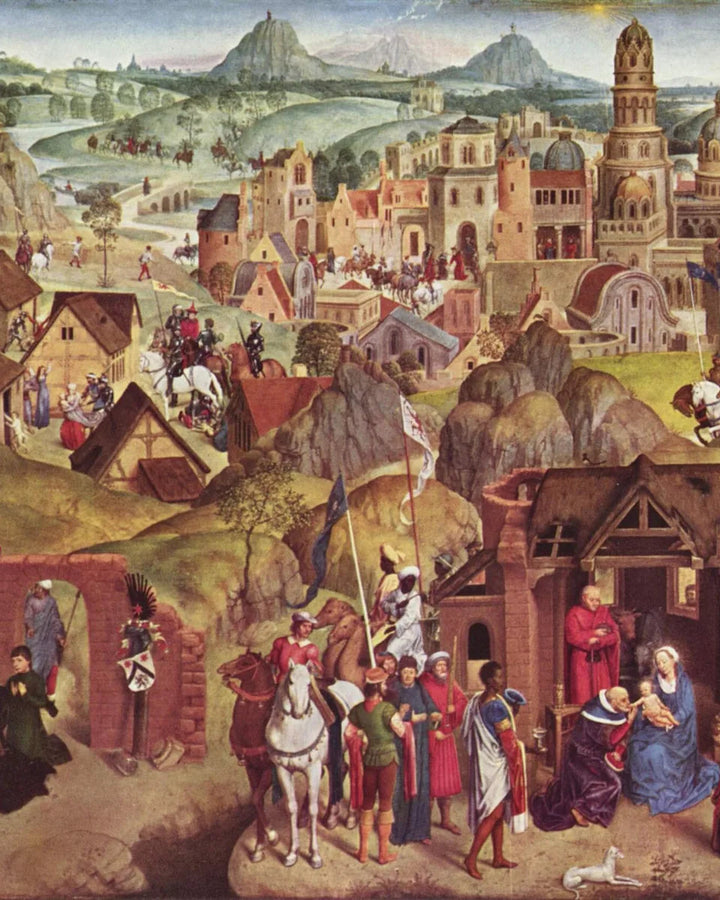
| The wise men kneel at the manger beside the shepherds | They come to "the house" and see "the young child" (Matthew 2:11) |
| The angels sing | The heavenly host are "praising God, and saying" (Luke 2:13) |
| Born on December 25 | Neither Gospel gives a day, a month or a season |
How painters put the whole story in one picture
Duccio's Nativity of 1308-1311 puts several steps of the story in one frame. His The Nativity with the Prophets Isaiah and Ezekiel, painted for the high altar of Siena Cathedral between 1308 and 1311 and now in the National Gallery of Art in Washington, shows Mary resting by the manger, angels above, the shepherds hearing the news at the right, and the prophets who foretold it standing at either side.
Duccio also paints the child being washed by two women and sets the birth inside a rocky cave. Neither detail is in Luke. The cave and the midwife come from the second-century Protevangelium of James, where Joseph finds "a cave there" and goes to seek a midwife, and Justin Martyr wrote in his Dialogue with Trypho that Joseph "took up his quarters in a certain cave near the village". Our guide to Nativity scene paintings across the centuries follows how the scene changed from Giotto to Correggio.
The CHRIST book, Mercy & Light's art book of the life of Jesus, opens with this story: its first chapter is the Nativity, told in the words of Luke and Matthew, with art made for each scene and the King James text set beside it. Its wise men arrive at a house beneath the star, as Matthew tells it. It sits with the rest of our art books of the life of Jesus.
What to read aloud on Christmas Eve
The usual Christmas Eve Bible reading is Luke 2:1-20, which takes about three minutes aloud in the King James words. Start at "And it came to pass in those days" and stop at verse 20, where the shepherds return praising God.
For a longer evening, read Luke 1:26-38 and Matthew 1:18-25 first, for Mary's yes and Joseph's dream. Keep Matthew 2 for January 6, Epiphany, when many churches remember the wise men at the house.
If you would like to read the whole story slowly through December, our Advent Bible reading plan, week by week gives a short passage for every day of the season in this same order. For the season itself, what Advent is and how it began explains why the waiting comes first, and our notes on keeping Christ at the centre of Christmas at home turn the reading into a family habit.
Why does Jesus' birth matter to Christians?
Jesus' birth matters to Christians because they believe God himself came into the world in it. Matthew gives the child the name "Emmanuel", God with us, and the angel calls him "a Saviour, which is Christ the Lord" (Luke 2:11, KJV).
John says the same without a manger: "the Word was made flesh, and dwelt among us" (John 1:14, KJV). For Christians, the child in Bethlehem is the start of the life that leads to the cross and the empty tomb.
This Christmas Eve, open Luke 2 and read it to whoever is in the room. Three minutes is enough for the shepherds to get home.
Frequently asked
What are the main events of the Christmas story?
The main events of the Christmas story are Gabriel's announcement to Mary, the angel’s message to Joseph, the road to Bethlehem, the birth of Jesus in a manger, the angels and shepherds, the presentation in the temple, the visit of the wise men and the flight into Egypt. Luke and Matthew each tell different scenes.
Is the Christmas story in Mark or John?
Neither Mark nor John tells the birth. Mark begins with John the Baptist, and John opens with "the Word was made flesh" (John 1:14, KJV), the meaning of Christmas without its events.
What is the best scripture for Christmas?
Luke 2:1-20 is the best single passage for Christmas, because it tells the birth, the manger, the shepherds and the angels in order. For one verse, Luke 2:10-11 carries the announcement, and Luke 2:14 the angels' praise.
Is Luke 2:14 a Christmas verse?
Yes. Luke 2:14 is the praise of the heavenly host on the night of the birth: "Glory to God in the highest, and on earth peace, good will toward men" (Luke 2:14, KJV). It follows the angel's news to the shepherds.
Is The Nativity Story film accurate to the Bible?
The 2006 film The Nativity Story follows Luke and Matthew closely in its main events, but it adds scenes, dialogue and characters the Gospels do not have, and it brings the wise men to the birth on the same night. For the account itself, read Luke 1-2 and Matthew 1-2.
Passages cited: Luke 1:5-25; Luke 1:26-38 (quoted: 1:31, 1:38); Luke 1:39-56 (quoted: 1:46); Matthew 1:18-25 (quoted: 1:20, 1:23); Matthew 1:25; Luke 2:1-5 (quoted: 2:1, 2:4, 2:5); Luke 2:6-7 (quoted: 2:7); Luke 2:8-14 (quoted: 2:8, 2:10-11, 2:13, 2:14); Luke 2:15-20 (quoted: 2:19, 2:20); Luke 2:11; Luke 2:21-38 (quoted: 2:29-30); Matthew 2:1-12 (quoted: 2:1-2, 2:11); Matthew 2:13-23 (quoted: 2:13, 2:16); Luke 2:39-40 (quoted: 2:40); John 1:14.

Mercy & Light
Mercy & Light crea arte y libros de la Escritura para el hogar, hechos con esmero y pensados para conservarse toda la vida. Cada artículo nombra el pasaje en el que se apoya, y cada referencia se comprueba contra el texto antes de publicarse. Sobre nosotros