
Religious Christmas decorations that keep Christ in the room
A walk through your house in December, room by room, ending with the one piece that is still on the wall when the boxes go back in the attic.
En este artículo
The tree is up, the garland is on the banister, and you are standing in the doorway wondering whether anyone walking in would know why. That is the job religious Christmas decorations do: they decide what the eye lands on first in each room. The best of them are the ones you do not pack away in January.
Can religious Christmas decorations be festive and still be about Him?
Yes, and the two are not fighting. A tree, a string of lights and a table full of food are ways of marking that something happened worth celebrating. The only question is whether the room also says what happened.
John puts the event in one sentence: "And the Word was made flesh, and dwelt among us" (John 1:14, KJV). Dwelt among us. A house decorated for Christmas is, at its best, a house arranged around that fact, and the decorations that matter most keep naming it after the party is over.
So rather than a list of things to buy, here is a walk through your house, room by room, with one honest suggestion for each.
What should people see from the front door?
Something that says why you are celebrating, not just that you are. The first thing a guest sees sets the tone for everything behind it.
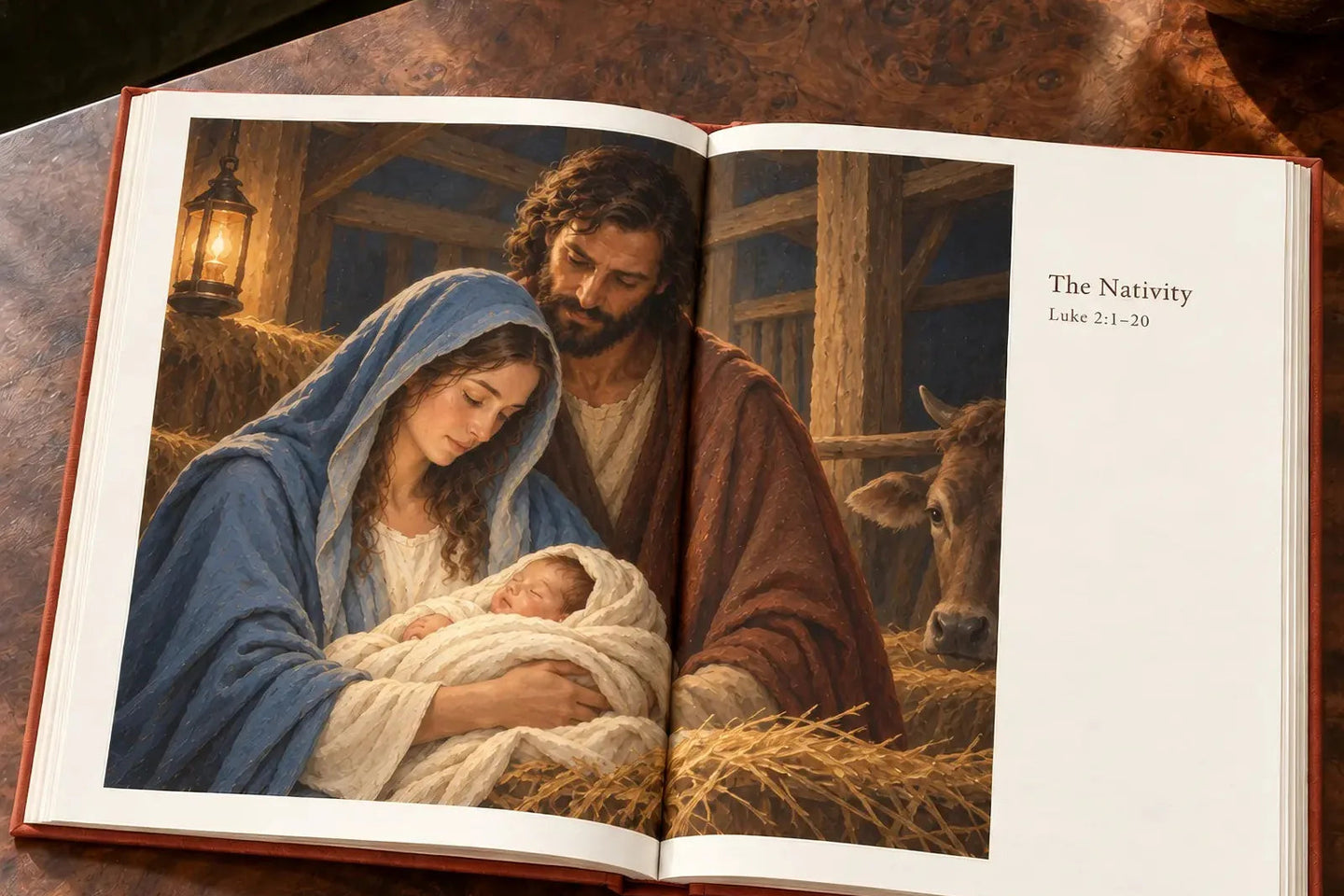
For most families that is the nativity. A set on the hall table or a low shelf is the plainest Christian decoration there is, and one of the oldest, and if you have one, this is where it belongs, at eye level with nothing in front of it. For how painters have told the same scene, from Giotto to Correggio, see our guide to famous Nativity paintings and the story they tell.
We do not make nativities and would not pretend otherwise. What we make is Scripture art that does a similar job at the end of the hall or on the wall facing the front door.
In His Presence is the piece we would hang there. A portrait of Jesus, steady gaze, gentle light, drawn from Matthew 11:28-30, where he says, "Come unto me, all ye that labour and are heavy laden, and I will give you rest." (Matthew 11:28, KJV).
A face at the end of a hall is a quiet greeting, and unlike the nativity it does not look seasonal. A 16x20 or 20x30 holds an entry wall; a 12x16 suits a narrow hallway.
What goes over the mantel or the sofa?
The one piece that does not come down. Most Christmas decorating happens in this room, and most of it is gone by the first week of January.
Think about what the living room looks like the day the tree goes out. The garland is boxed, the stockings are in the attic, and the wall above the sofa is bare again, or back to whatever was there before, which in a lot of homes is nothing in particular.
A canvas hung for Christmas changes that. It goes up in December as part of the season and stays because it belongs to the house, not to the holiday, so choose it the way you would choose any Christian wall art for the living room.
Above the Waves is the one we would put there. Jesus walks toward the boat across a restless sea, from Matthew 14:22-33, where the disciples are out on the water at night with the wind against them. When they see him and are afraid, he says, "Be of good cheer; it is I; be not afraid." (Matthew 14:27, KJV).
Many readers see in that scene a household in a hard season, small and rocking and not alone. That is an interpretation, but it is one a living room can carry all year. At 24x36 or 30x40 it holds the wall above a sofa; at 20x30 it sits well over a mantel, depending on how wide the fireplace is.
In December, let the greenery sit below or beside it rather than across the top. A canvas does not need garland draped over it to look like Christmas. The room already does.
What goes on the table?
An Advent wreath. A circle of greenery with four candles, one lit each Sunday before Christmas, and in many homes a fifth white candle in the middle for Christmas Day. We do not sell them. Any florist or church bookshop will have one, or you can make one from a wire ring and cut greens from the yard. If the season itself is new to you, our guide to what Advent is and when it begins covers it in a few minutes.
The point of it is the pacing. A house with a wreath on the table has a built-in reason to sit down once a week, light a candle, and read a short passage together before dinner. Luke 2 belongs to the last Sunday; the earlier ones suit Isaiah 9 or the opening of John. For a passage to read every evening, our Advent reading plan for the four weeks before Christmas lists one for each day.
Traditions differ on candle colors and which reading goes with which week; our guide to what each Advent wreath candle means and the order to light them sets out the common pattern. Follow your own church's, not ours.
What goes in the children's rooms?
A shepherd. Children understand the shepherds before they understand anything else about Christmas, and Luke's account begins the night with them: "And there were in the same country shepherds abiding in the field, keeping watch over their flock by night." (Luke 2:8, KJV).
A shepherd scene is the right piece for a child's room, and one of the few that will not look odd in June. Safe in His Care, our Good Shepherd painting from John 10:11-15, shows the shepherd holding a lamb close while wolves wait beyond his reach.
It is not a nativity, but a child makes the connection at once: the shepherds went to see the baby, and the baby grew up to call himself the shepherd.
A 12x16 over a small bed is the size we would choose. You can find it at /products/safe-in-his-care.
Read Luke 2 aloud in that room at least once in December. The picture will mean more after the story than before it.
What about the front door itself?
Keep it simple. The front door is the one place a decoration is only ever seen for a few seconds, so a plain evergreen wreath and a small tag with a short verse is enough.
Isaiah's line is the one most people know and the one that reads at a glance: "For unto us a child is born, unto us a son is given" (Isaiah 9:6, KJV).
Write it on a wooden tag or a piece of heavy card, tie it to the wreath with ribbon, and let the weather do what it does. If the tag fades by New Year, that is fine. It has done its job.
Why does the canvas end up staying?
Because nearly everything else in this article is in a box by the first week of January, and the canvas is not. That changes how you should choose it.
Buy it as if Christmas were not the reason, the same rule we use for Christian Christmas gifts chosen for the person. Ask whether it belongs in that room in March, whether the size fits the wall rather than the season, and whether the scene is one you want to look at on an ordinary Tuesday.
None of our canvases is a nativity or a winter scene, and that is on purpose; they come from passages people live with all year. The Nativity itself, from the Annunciation to the wise men, opens CHRIST, our art book of the life of Jesus.
Each is printed to order on matte canvas over a pine stretcher, frameless or in a natural or black pine frame, in sizes from from 8x12 to 30x40 inches, with hanging hardware included. Frameless runs from $59 to $129; framed from $129 to $319. They are gathered, with the rest of the season's pieces, in our Christian Christmas gifts collection.
The room after the tree
The test is not how the house looks on the twenty-fourth. It is what is still saying something on the fifteenth of January, when the boxes are back in the attic and the room has gone quiet.
A nativity by the door for four weeks, a candle on the table on Sunday evenings, a verse on the wreath, and one piece of art on the main wall that stays. That is enough to keep Christ in the room, in December and after, when it is just you and the lamp and the sofa again.
Frequently asked
What counts as a religious Christmas decoration?
Anything that names the reason and not just the season: a nativity, Scripture art, an Advent wreath, a verse on a card or a tag. Lights and greenery are not religious on their own, but they are not in the way either.
Where does Scripture art go if the tree takes the main wall?
Move the art, not the tree. The wall opposite the tree, the entry or the dining room all work for December, and in January the piece goes back to the main wall. Pick a size that suits both spots; 16x20 and 20x30 move between rooms without looking wrong.
Will Christmas art look out of place in February?
Not if the scene is not a Christmas scene. A nativity canvas feels seasonal by spring; Jesus on the water or the Good Shepherd with a lamb does not. Choose the piece for the passage, not the holiday, and it stays.
Passages cited: John 1:14; Matthew 11:28-30; Matthew 14:22-33 (14:27 quoted); Luke 2:8; John 10:11-15; Isaiah 9:6

Mercy & Light
Mercy & Light crea arte y libros de la Escritura para el hogar, hechos con esmero y pensados para conservarse toda la vida. Cada artículo nombra el pasaje en el que se apoya, y cada referencia se comprueba contra el texto antes de publicarse. Sobre nosotros


