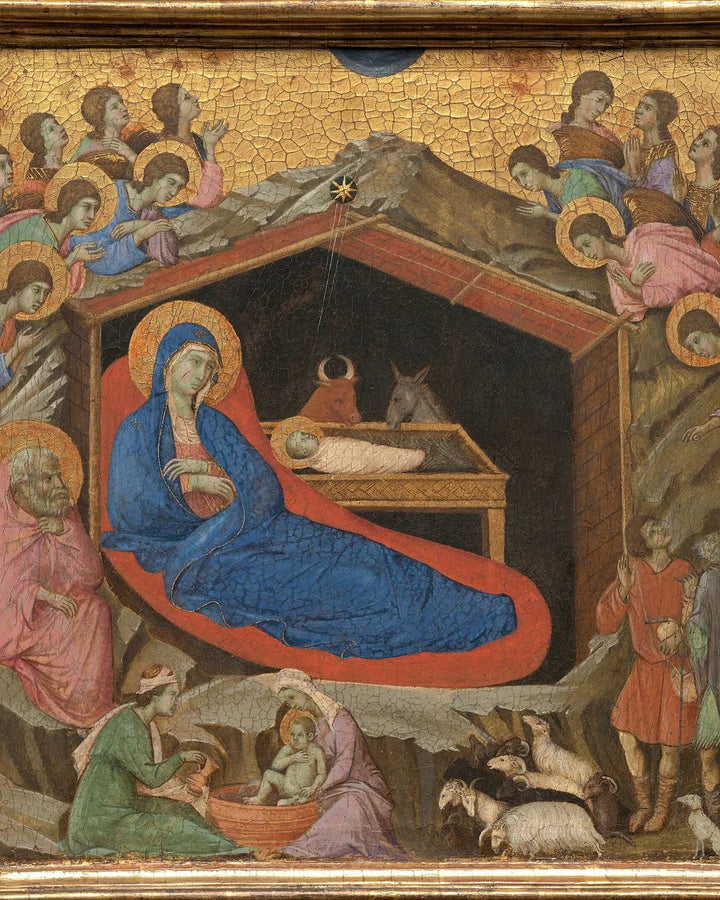
Was Jesus born on Christmas? The Bible and December 25
What the Gospels say and do not say about the day Jesus was born, the earliest evidence for December 25, the two main explanations for the date, and how Christians keep it.
En este artículo
Was Jesus born on Christmas? Probably not, and nobody knows for certain. The Bible never names a day, a month or even a season for the birth of Jesus. Most historians place it a little before 4 BC, at an unknown time of year.
Christmas falls on December 25 because the church in Rome was keeping that date by the fourth century. How it got there is older, and less cynical, than the version that does the rounds every December.
What does the Bible say about when Jesus was born?
The Bible places the birth of Jesus in history but not on the calendar. Luke ties it to a Roman census ordered by Caesar Augustus, and Matthew to the reign of Herod the king. Neither Gospel gives a day or a month, and no other book of the Bible does either.
Luke writes: "And it came to pass in those days, that there went out a decree from Caesar Augustus, that all the world should be taxed. (And this taxing was first made when Cyrenius was governor of Syria.)" (Luke 2:1-2, KJV). Matthew says that "Jesus was born in Bethlehem of Judaea in the days of Herod the king" (Matthew 2:1, KJV).
Herod is usually dated as dying in 4 BC, so most historians place the birth around 6 to 4 BC. The census is harder: the census under Cyrenius (Quirinius) known from ancient histories took place in AD 6, about ten years later, and scholars still debate how to square the two.
You can read the whole account, step by step, in the Christmas story from the Bible, in order.
Could Jesus have been born in winter?
Jesus could have been born in winter, or in any other season; Luke gives none, and nothing in the text rules December in or out. The clue most people cite is the shepherds: "there were in the same country shepherds abiding in the field, keeping watch over their flock by night" (Luke 2:8, KJV).
Judean winter nights are cold and wet, so many readers take the shepherds as a sign of spring or autumn. It is a fair inference, and only that. Luke does not say why these shepherds were out.
Others count from Zechariah's turn in the temple, "the course of Abia" (Luke 1:5, KJV), and Gabriel's visit to Mary "in the sixth month" (Luke 1:26, KJV). Depending on the starting guess, that count lands in autumn or in late December.
| Question | What the KJV text says | What is inference |
|---|---|---|
| The day and month | Nothing | December 25, January 6 and every other date |
| The season | Shepherds in the field by night (Luke 2:8) | That it was not winter |
| The time of day | The angel tells the shepherds by night: "unto you is born this day" (Luke 2:11) | That the birth itself was at midnight |
| The year | Herod's reign (Matthew 2:1); a census under Cyrenius (Luke 2:2) | About 6 to 4 BC |
| The snow | Nothing | Every snowy Christmas card |
Why is Christmas on December 25?
Christmas is on December 25 because Christians in Rome had come to believe, by the fourth century, that this was the day of Christ's birth. Historians give two main explanations for how they arrived at it: the Roman winter feasts, and a count from the date of the crucifixion. Both have support, and neither is proven.
The first explanation: the winter feasts
The better-known theory holds that the church set Christmas against Rome's winter festivals. The emperor Aurelian raised a temple to the Unconquered Sun in 274, and by the fourth century the Roman calendar marked December 25 as the sun's birthday. A feast of Christ on that day gave Christians the "Sun of righteousness" (Malachi 4:2, KJV) in place of the sun.
Saturnalia, the feast most often named, ran in mid-December and was over before the 25th. Some fourth-century preachers did compare Christ's birth with the sun's, but the claim that the date was chosen to replace a pagan feast first appears in a twelfth-century note.
The second explanation: counting from the cross
The second theory starts from Good Friday. Around 200, Tertullian dated the crucifixion to "the eighth day before the calends of April", March 25, in Tertullian, An Answer to the Jews 8. Some Christians held that Jesus was conceived on the same day of the year he died, and nine months on from March 25 is December 25.
Augustine sets out the whole reckoning: "He is believed to have been conceived on the 25th of March, upon which day also He suffered", and "born, according to tradition, upon December the 25th", in Augustine, On the Trinity 4.5. Churches in the East counted from a spring date in their own calendar and arrived at January 6.
Who first said Jesus was born on December 25?
The first writer said to give December 25 is Hippolytus of Rome, in a commentary on Daniel from the early third century, though some scholars think that line was added later. The first certain record is a Roman almanac of AD 354, whose list of feasts opens with that day: "natus Christus in Betleem Iudeae", Christ born in Bethlehem of Judaea.
Before that, nobody agreed. Around 200, Clement of Alexandria listed the dates Christians in Egypt proposed, among them "the twenty-fifth day of Pachon" and "the twenty-fourth or twenty-fifth of Pharmuthi", both in spring, in Clement, Stromata 1.21. December 25 is not among them.
| When | Who or what | What it says |
|---|---|---|
| Late 1st century | Matthew and Luke | The birth in Herod's reign, at a census; no date |
| About 200 | Clement of Alexandria | Several dates proposed in Egypt; none in December |
| About 200 | Tertullian | The crucifixion on March 25 |
| Early 3rd century | Hippolytus, on Daniel | December 25 (the line may be a later addition) |
| 221 | Julius Africanus | The conception on March 25 |
| 336 to 354 | A Roman almanac (the Chronography of 354) | Christ's birth on December 25, at the head of the church's feasts |
| Late 4th to 5th century | Churches in the East | Most adopt December 25 after keeping the birth on January 6 |
| Early 5th century | Augustine, On the Trinity | Conceived March 25, born December 25 "according to tradition" |
January 6 did not disappear. In the West it became Epiphany, the feast of the wise men; in the East it marks Christ's baptism. The Armenian church still keeps the birth on January 6, and Orthodox churches on the old Julian calendar keep December 25 on what most of the world calls January 7.
Why is the birth of Jesus shown in snow?
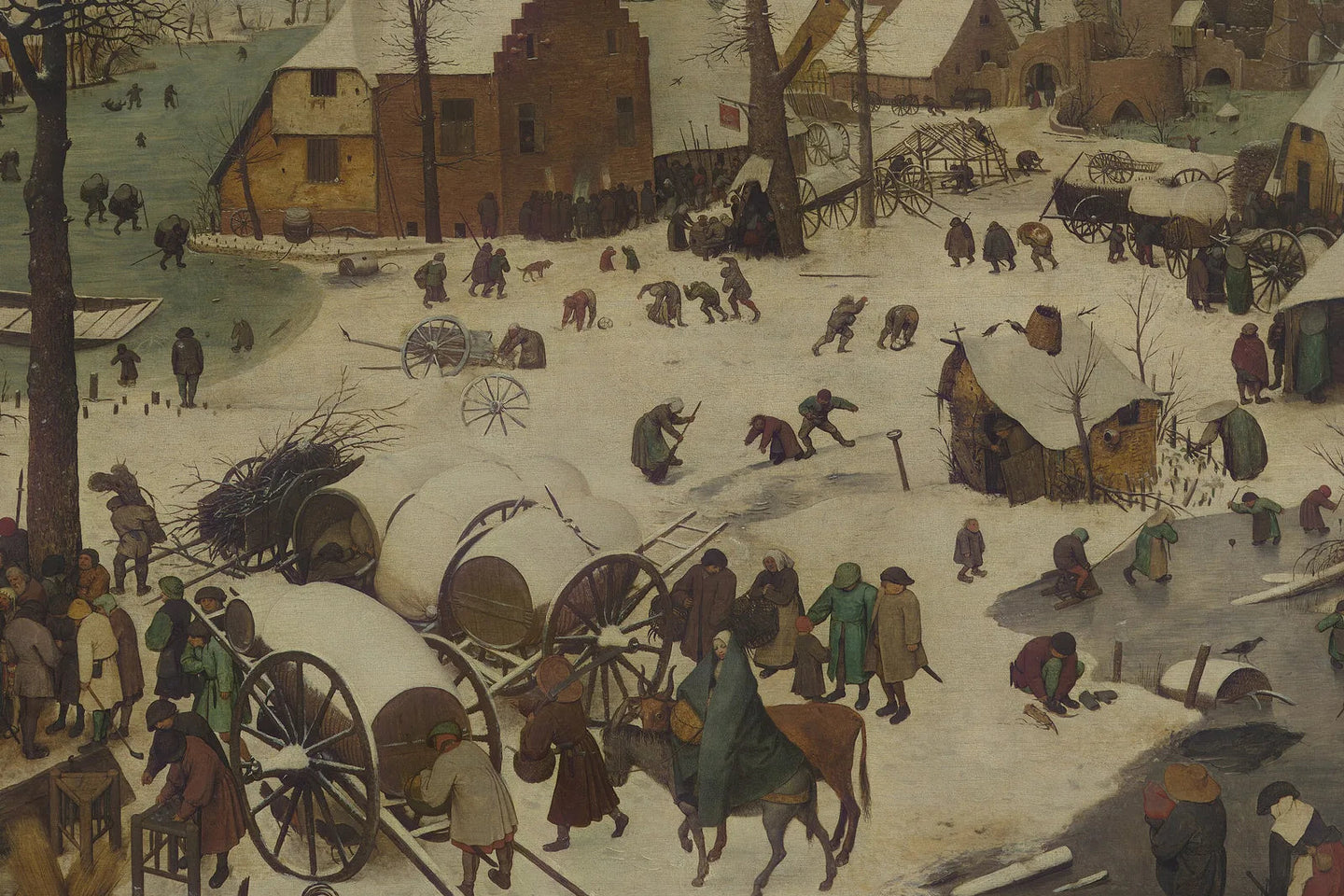
The birth of Jesus is shown in snow because European painters set it in their own December, when their churches kept it. Scripture gave them no season, so they painted the one outside the window. In 1566 Pieter Bruegel the Elder turned Luke's census into a Flemish village under snow, with a frozen pond and a low red sun.
That painting, The Census at Bethlehem, hangs in Brussels, where the Royal Museums of Fine Arts of Belgium count it among his winter scenes. Look for Mary on a donkey in a blue cloak, Joseph walking ahead, and the village crowding an inn door to be registered.
Luke gives no donkey and no snow, yet the scene is unmistakably his decree. For the night scenes and the manger, from Giotto to Correggio, see how painters have shown the Nativity scene.
Does it matter that we don't know the date?
For most Christians the date of Jesus's birth matters far less than the birth itself, and the Bible's own emphasis points the same way. Paul gives no day at all: "But when the fulness of the time was come, God sent forth his Son, made of a woman, made under the law" (Galatians 4:4, KJV).
The first Christians kept Easter long before anyone kept Christmas, because the Gospels tie the crucifixion to Passover. December 25 is a remembrance, kept by tradition, and the meaning of the day does not hang on the calendar.
For many families it is simply the night the story is read. Luke 2:1-20 takes about four minutes aloud, ending with the shepherds "glorifying and praising God for all the things that they had heard and seen" (Luke 2:20, KJV). Many save Matthew's wise men for January 6, and our Christmas Bible verses in the King James words gather the rest.
The season before it, Advent and how it leads to Christmas, explains the four weeks of waiting. Our notes on keeping Christ at the centre of Christmas turn them into habits at home, and the story of the wise men's gold, frankincense and myrrh picks up where Luke leaves off.
If you would like to see the story as well as hear it, the CHRIST book, Mercy & Light's art book of the life of Jesus, opens with the Nativity, with art made for each scene. It sits with the rest of our art books of the life of Jesus, and the story goes on in the life of Jesus told in order.
Whatever the true day was, the candle on the table and the passage read beside it are what the date is for.
Frequently asked
Is Christmas Jesus's real birthday?
Christmas is the day the church keeps Jesus's birth, not a recorded birthday. The Bible gives no date, and December 25 was settled in Rome by the fourth century. Christians keep it as a remembrance of the birth itself.
Where in the Bible is the birth of Jesus?
The birth of Jesus is told in Luke 1-2 and Matthew 1-2. Luke tells of the decree, the manger and the shepherds; Matthew tells of Joseph's dream, the wise men and the flight into Egypt. Mark and John do not tell the birth.
What year was Jesus born?
Most historians place the birth of Jesus between about 6 and 4 BC. Matthew sets it "in the days of Herod the king" (Matthew 2:1, KJV), and Herod is usually dated as dying in 4 BC. The year 1 on our calendar comes from a later miscalculation.
Was Jesus born at night?
The Bible does not say what time Jesus was born. Luke says the angel came to shepherds keeping watch "by night" and told them "unto you is born this day" (Luke 2:8, 11, KJV). The midnight services many churches hold on Christmas Eve draw on that reading.
Why do some churches celebrate Christmas on January 7?
Orthodox churches that use the older Julian calendar keep Christmas on December 25 by that calendar, which now falls on January 7 by ours. The Armenian church keeps the birth on January 6, the older Eastern date.
Passages cited: Luke 2:1-2 (quoted); Luke 2:1-20; Luke 2:8 (quoted); Luke 2:11 (quoted); Luke 2:20 (quoted); Luke 1:5 (quoted); Luke 1:26 (quoted); Matthew 2:1 (quoted); Malachi 4:2 (quoted); Galatians 4:4 (quoted).

Mercy & Light
Mercy & Light crea arte y libros de la Escritura para el hogar, hechos con esmero y pensados para conservarse toda la vida. Cada artículo nombra el pasaje en el que se apoya, y cada referencia se comprueba contra el texto antes de publicarse. Sobre nosotros