Psalm 23 art: bringing "The Lord is my shepherd" onto your wall
The six verses you already half know by heart, what a shepherd would have heard in each one, and how to choose a shepherd painting for a nursery, a bedroom or your mother's room.
In this article
You already know the first line. Maybe you learned it in a Sunday school room with a felt board, or heard it read at a graveside with the wind in the flowers, and either way it is in you. The LORD is my shepherd.
Psalm 23 art brings that line into a room, in one of two ways: the words themselves, usually the opening, or the picture the words describe, a shepherd with his flock. The psalm is six verses long. The whole thing takes half a minute to read.
What does Psalm 23 say?
Six verses, spoken by a sheep, so to speak: someone describing what it is to be kept by a good shepherd. The heading calls it "A Psalm of David," and David kept his father's sheep before he was a king. Here it is in full.
The LORD is my shepherd; I shall not want.
He maketh me to lie down in green pastures: he leadeth me beside the still waters.
He restoreth my soul: he leadeth me in the paths of righteousness for his name's sake.
Yea, though I walk through the valley of the shadow of death, I will fear no evil: for thou art with me; thy rod and thy staff they comfort me.
Thou preparest a table before me in the presence of mine enemies: thou anointest my head with oil; my cup runneth over.
Surely goodness and mercy shall follow me all the days of my life: and I will dwell in the house of the LORD for ever.
(Psalm 23:1-6, KJV)
What did each line mean to a shepherd?
To someone who kept sheep in the hills of Judah, the psalm is not a set of metaphors. It is a working day. Every line names a thing a shepherd does, and the comfort is that God is described as doing all of them.
"I shall not want" means I shall lack nothing. Sheep cannot find their own pasture in dry country; a shepherd leads them to it, and the line says the leading is reliable.
Green pastures and still waters are the rest and the drink he finds for them. Grazing there is seasonal and scattered, and the shepherd's skill is knowing where the flock can safely lie down.
"He restoreth my soul" uses a Hebrew word for life or breath, and the plain sense is that he brings me back to myself. Some readers connect it to the shepherd who goes after the straying sheep and carries it home, the picture Jesus draws in Luke 15; that is a reading the text invites rather than states.
Paths of righteousness are, most simply, right paths, the ones that lead somewhere good.
Then the valley. The Judean hills are cut by steep ravines a flock has to pass through to reach the next grazing, and in a narrow one the light goes early. The psalm does not say the shepherd spares the sheep the walk. It says he walks it with them.
The rod was a short club for driving off animals; the staff was the long crook for guiding, and for lifting a sheep out of a crevice.
David knew the danger firsthand. In 1 Samuel 17 he tells Saul how he went after a lion and a bear that took lambs from his father's flock. The rod and staff comfort because the tools of protection are close enough to see.
Verses 5 and 6 change the picture. The shepherd becomes a host who lays a table, anoints a guest's head with oil and fills a cup past the brim. Many readers take the two halves as one movement, from being kept in the field to being welcomed home. The psalm itself does not explain the shift.
What does Psalm 23 art usually show?
Almost always verses 2 through 4: the resting flock, the water, the dark valley with the shepherd walking ahead. Those are the lines with a landscape in them. The table and the cup give a painter less to work with, so the first verse is more often lettered than painted.
The earliest Christian art, in the Roman catacombs of the third century, already shows a young shepherd with a sheep across his shoulders, the first of eighteen centuries of Good Shepherd paintings. That figure comes from the Gospels as much as from the psalm, but Christian readers have from the beginning heard the psalm's shepherd as Christ.
Jesus' own words make the link: "I am the good shepherd: the good shepherd giveth his life for the sheep." (John 10:11, KJV)
That is an interpretation, one the New Testament invites, and it is why pictures of the psalm and pictures of the Good Shepherd have been the same picture for most of Christian history.
By the 1800s the psalm was a standard print for parlors and Sunday school rooms: a shepherd in a pale landscape, sheep at his feet, often a lamb in his arms. Painters today tend to strip that back. The landscape gets simpler, the light warmer, and the picture narrows to one shepherd and one sheep. Ours does the same.
Why is a shepherd holding a lamb Psalm 23 without the words?
Because the psalm is spoken from inside the flock, and a painting of the shepherd holding a lamb shows the same moment from the other side. The sheep says, I am fed, I am led, I walk through the dark and I am not afraid because you are with me. The picture shows the one who is with him.
The prophets drew that picture before any painter did. Isaiah describes God this way: "He shall feed his flock like a shepherd: he shall gather the lambs with his arm, and carry them in his bosom, and shall gently lead those that are with young." (Isaiah 40:11, KJV)
Jesus finishes the thought in the parable of the lost sheep, where the shepherd finds it and lays it on his shoulders. Set those beside Psalm 23:4 and you have the whole thing: a lamb that could not survive the valley alone, and a shepherd who carries it through.
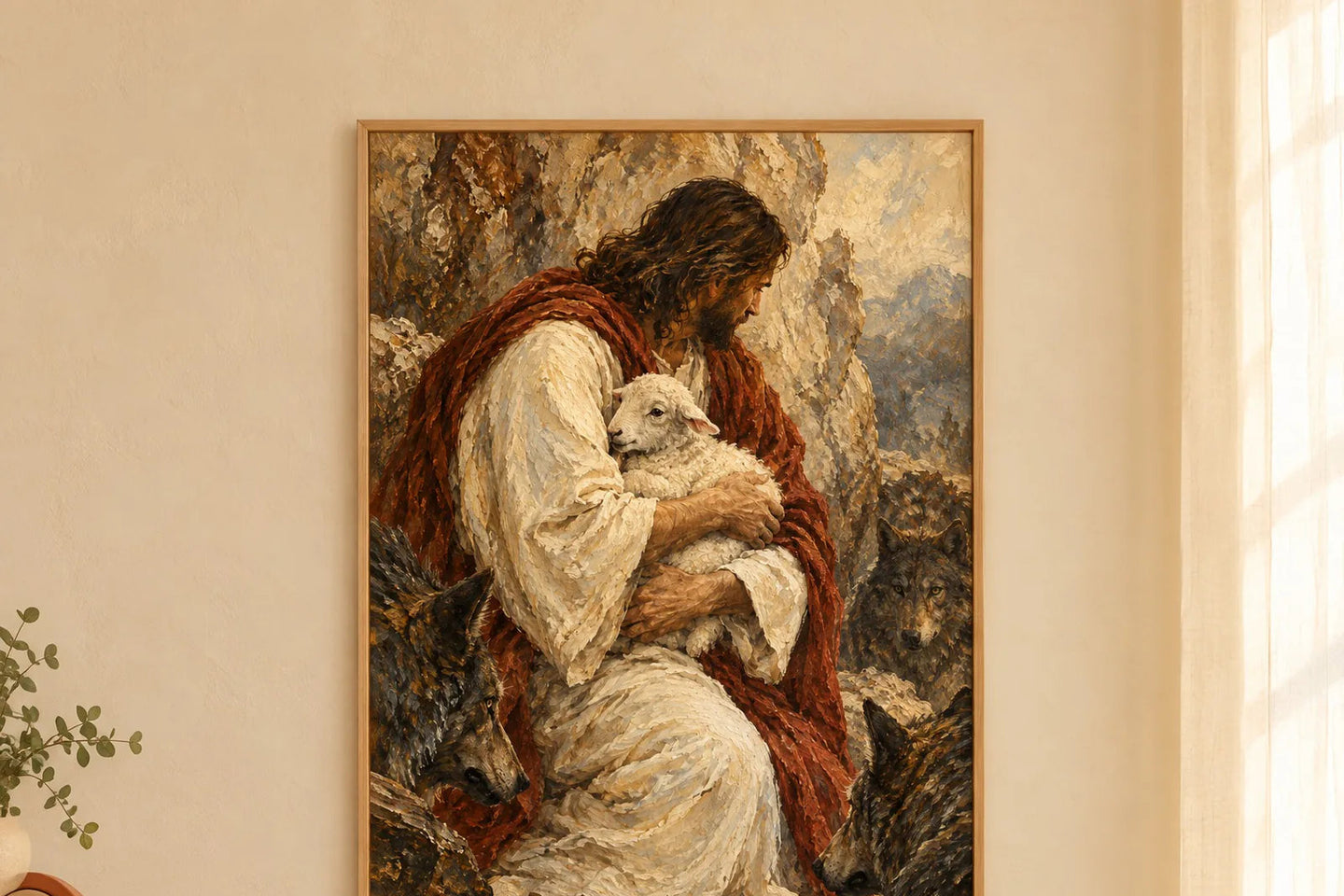
Safe in His Care is our canvas of that moment. The Good Shepherd holds a lamb close against him while wolves wait at the edge of the scene, beyond his reach and kept there.
We made it with John 10 in mind, where the shepherd stands between the sheep and the wolf, but many people who hang it see verse 4 of the psalm first: the valley, the danger real, the sheep unafraid.
It is in our Bible story art collection, on matte cotton-polyester canvas over solid pine, frameless or in a natural or black pine frame, made to order in the US.
Is it right for a nursery?
Yes. A shepherd holding a lamb says over a sleeping child exactly what you want said, and the psalm is short enough that she will know it by heart before she can read.
For a nursery, pair the picture with the words. A lettered print of the first verse in big plain type beside the painting gives a child both the sentence and the scene, and the two teach each other, which is most of our answer to whether to hang verse art or scene art.
Go with one of the smaller sizes, since the wall is small and the viewer is close, and hang it where you can see it from the chair where you feed and rock.
One honest note about Safe in His Care in particular. The wolves are in the picture. They are small and far off and clearly kept away, and some parents like that the danger is shown and held back rather than pretended away. Others want a picture with no threat in it at all, so look closely before you decide.
Where does it go in a bedroom?
Above the bed, or on the wall you face when you lie down. Verse 4 is a night verse, and a bedroom is where most of us meet the dark.
Above a headboard, use one of the larger sizes alone or a pair of medium ones, and leave a hand's width or more between the headboard and the canvas.
On the facing wall, choose whatever size reads clearly from the pillow without your glasses. Keep the rest of the wall quiet. One shepherd and nothing competing with him is the whole idea.
What about my mother's room, or memory care?
Psalm 23 is one of the passages people learn earliest and keep longest, and a picture of it can reach where words no longer do.
In a care room, a shepherd painting at eye level from the bed or the chair, with the first verse lettered beside it in large clear type, is one of the kindest things you can put on the wall.
Keep it simple. One familiar picture, the words in the translation she grew up with, nothing that needs explaining.
Psalm 23 is one of the psalms most often read at funerals, and there is something right in letting a parent hear it now, every day, as a promise about being kept rather than later as a farewell. The two readings are the same psalm. The difference is when you hang it.
What size should it be?
Big enough to see from where you actually sit or lie, and in proportion to the furniture under it. Our shepherd painting comes in six sizes, from 8x12 to 30x40 inches, and frameless from $59.
The smallest suits a nursery shelf or a bedside table. The middle sizes hang beside a crib, above a dresser or on the bedroom wall you face. The largest belong above a bed on their own or on a living room wall.
Framed sizes run from 12x16 to 30x40 inches, and sizes describe the canvas face; the outer frame adds to the overall dimensions, so allow for that when you measure. Every canvas comes with hanging hardware included.
Company in the valley
The psalm never promises that the valley is skipped. It promises company through it, and a table at the far end.
That is why people who have not opened a Bible in years still know these six sentences, and why a picture of a shepherd holding a lamb needs no caption beside a crib or a hospital bed. Hang it where the dark is, and let it say what it has always said to whoever is lying there.
The Psalms, in a book to keep close
The same words can have a place on your table. PSALMS, our forthcoming clothbound art book, brings together the prayers, poetry and praise of the Psalms through illustrations and selected Scripture. Explore it alongside the CHRIST and NATIVITY books in our book collection. PSALMS is coming soon; join the waitlist to hear when ordering opens.
Frequently asked
Who wrote Psalm 23?
The heading credits it to David, who kept his father's sheep before he was king. The text itself does not say when or why he wrote it.
What is the difference between Psalm 23 art and Good Shepherd art?
Mostly the label. Pieces sold under the psalm usually show the landscape of verses 2 through 4, pastures, water and the valley, while Good Shepherd pieces, drawn from John 10 and Luke 15, focus on the shepherd himself, often carrying a lamb. Christian readers have joined the two from the beginning, and most shepherd paintings answer to either name.
Which verse of Psalm 23 is best for a lettered print?
The first, "The LORD is my shepherd; I shall not want," is the shortest and the best known, and it reads from across a room. Verse 4 is the one people reach for in hard seasons. If you want the whole psalm on the wall, give it generous type; six verses in small letters is a poem nobody reads.
Why does the King James say "I shall not want"?
In the English of 1611, to want something meant to lack it. The line means I shall lack nothing, not I shall have no wishes. Newer translations say "I lack nothing" or "I shall not be in want," which is the same sense in newer words.
Passages cited: Psalm 23:1-6 (quoted in full); 1 Samuel 17:34-36 (paraphrased); Luke 15:4-7 (paraphrased); John 10:11 (quoted); John 10:11-15 (mentioned); Isaiah 40:11 (quoted).

Mercy & Light
Mercy & Light makes art and books of Scripture for the home, crafted with care and made to be kept for a lifetime. Every article names the passage it rests on, and every reference is checked against the text before it is published. About us