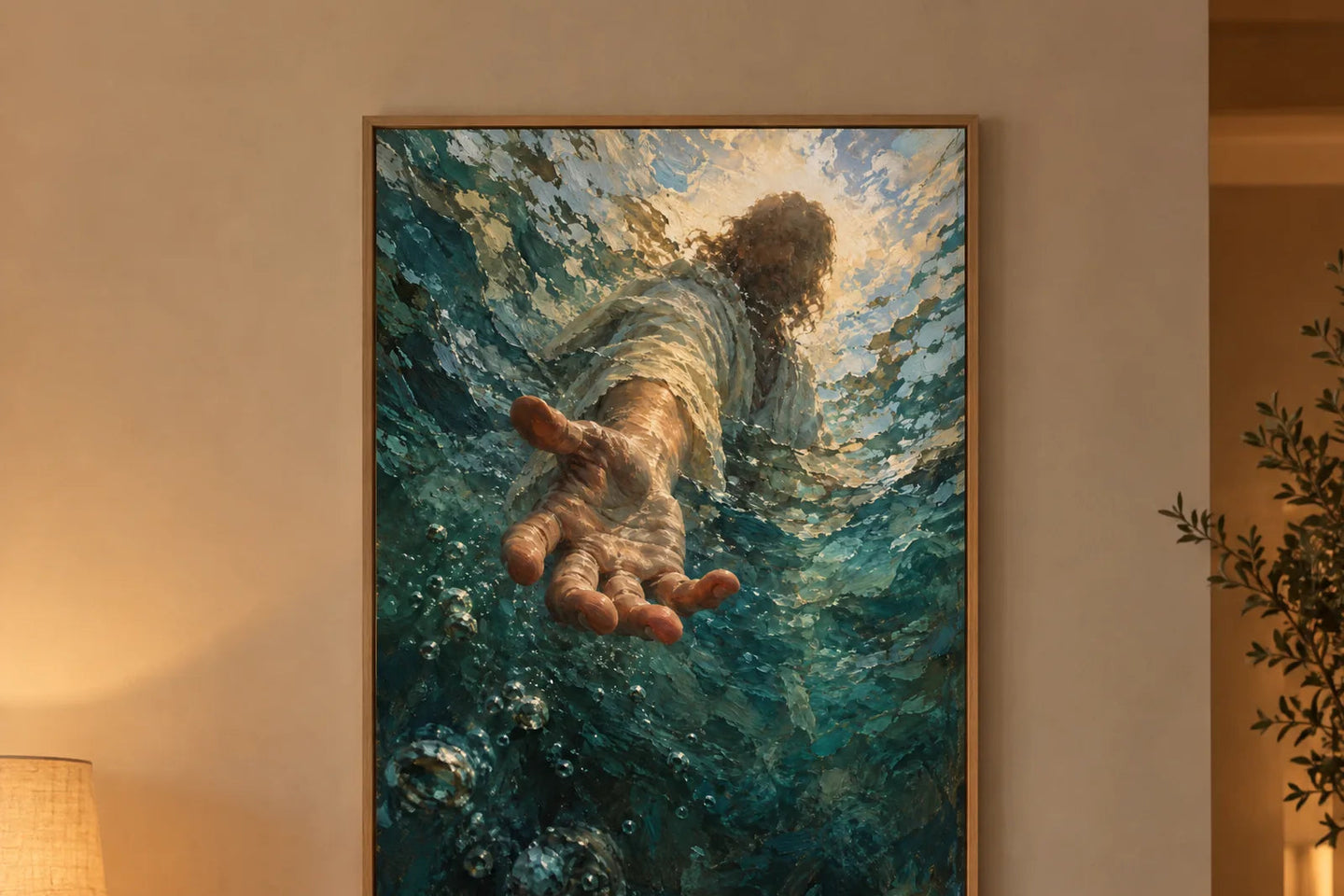
Jesus reaching into the water: the story behind the painting
Two verses in Matthew 14, a three-word prayer, and why a hand breaking the surface of the water is the picture so many people want on the wall in a hard year.
En este artículo
The water is over his head. A minute ago Peter was walking on the sea, actually walking, and then he looked at the wind, and now he is going under with the lake in his mouth. He gets three words out.
The picture of Jesus reaching into the water comes from the two verses that follow. A hand comes down, takes hold, and the rest of the story happens in the boat. That hand breaking the surface has become one of the most loved images of Jesus in modern homes, and Reaching Through the Water is our canvas of it.
What actually happens in those two verses?
Peter sinks, cries out, and is caught. Matthew tells it in two verses, and the second one opens with the word that matters most.
But when he saw the wind boisterous, he was afraid; and beginning to sink, he cried, saying, Lord, save me. And immediately Jesus stretched forth his hand, and caught him, and said unto him, O thou of little faith, wherefore didst thou doubt? (Matthew 14:30-31, KJV)
A little context. It is the fourth watch of the night, and the disciples have been rowing against the wind for hours. Jesus comes to them walking on the sea; they take him for a ghost, and he tells them to be of good cheer. Then Peter speaks up:
And Peter answered him and said, Lord, if it be thou, bid me come unto thee on the water. (Matthew 14:28, KJV)
Jesus says, Come. Peter climbs down out of the ship and walks toward him on the water. Then he looks at the wind.
Notice the order in verse 30. He saw, he was afraid, he began to sink, he cried. The fear comes before the sinking, and the cry comes when he is already going under.
Whatever else the passage teaches, it is honest about how people behave in trouble. Most of us do not pray at the first gust either.
What does Peter say?
Lord, save me. Three words in English, and not many more in the Greek. It is not a prayer of great faith; Jesus says as much in the next breath. It is a prayer of great need, and it is answered anyway.
There is relief in that. Peter does not explain himself, apologize for climbing out, or promise to do better. He names who he is talking to and what he needs, and it turns out to be enough.
Sitting in the car in the hospital parking lot, that may be the only prayer you can manage. It was enough for him.
Then the word immediately. Matthew does not say Jesus waited to see whether Peter would find his footing. The hand is already moving.
The rebuke, "O thou of little faith, wherefore didst thou doubt?", comes after the catch, not before it, and it is spoken by someone who already has hold of him.
Many readers take this as the heart of the passage: the correction comes from inside the rescue, not as a condition of it. That is a reading rather than something the text spells out, but the order of the verbs supports it.
Why did the picture of Jesus reaching into water become so loved?
Because it shows the rescue from Peter's side. Older paintings of Jesus walking on water stand you on the shore or in the boat, watching the whole thing from a distance. The modern image puts you under the surface, looking up at a hand coming through the water for you.
That changes what the picture is for. A wide view of the boat, the disciples and Christ on the waves is a picture of a miracle. A hand coming down through the water is a picture of being helped. You are not watching Peter; you are Peter.
We think that is why the image spread so far in recent decades, onto canvases and church walls and phone lock screens. It needs no caption and no Sunday school. Anyone who has ever been in over her head knows what a hand reaching down means.
It also draws on something much older than Matthew: the hand of God reaching down to pull someone out of the water. David sings it in Psalm 18: "He sent from above, he took me, he drew me out of many waters" (Psalm 18:16, KJV).
Psalm 69 opens with a man who feels the water at his throat: "Save me, O God; for the waters are come in unto my soul. I sink in deep mire, where there is no standing: I am come into deep waters, where the floods overflow me" (Psalm 69:1-2, KJV).
And in Isaiah, God says, "For I the LORD thy God will hold thy right hand, saying unto thee, Fear not; I will help thee" (Isaiah 41:13, KJV).
Many readers see the hand in Matthew 14 as that older hand-of-God picture given a body and a face. The Gospel does not draw the line itself; it simply tells what happened. But it is hard to read those psalms and then the fourth watch of the night without hearing one inside the other.
How does Reaching Through the Water show it?
You are under the surface, looking up. Above you Jesus leans over the water with warm light behind him, and his hand comes down through the surface, open, almost close enough to take.
The water is deep teal and sea blue, dense and dark at the bottom of the canvas and brightening toward the top, where the surface breaks into warm ivory light. Bubbles rise past you.
His face is above the water, softened by the surface and by the glow behind him, so the sharpest thing in the picture is the hand: palm toward you, fingers open. That was the point. It is what Peter saw.
We chose the moment carefully. Not the moment after, with Peter safe and the wind gone. The instant the hand arrives, between "Lord, save me" and "immediately," while the water is still over your head.
The painting takes the passage as a rescue seen from inside the need. That is an interpretation, and we are open about it; the Gospel gives the words and the order of events, and the viewpoint is ours.
The texture is loose and painterly, and it is part of the printed image. On the larger sizes the hand comes close to life size.
Who is this canvas for?
Two people. Someone in a hard season of her own, and someone who wants to say something to a friend and cannot find the words.
The first is simple. A diagnosis, a funeral, a marriage under strain, a job that ended, a son you are worried about. In those months the last thing you want on the wall is a picture telling you to cheer up.
This one does not. It admits that you are under the water. It only insists that a hand is already on its way, and that the cry it answers is a short one. Hang it where you will see it first thing, or from the bed, or above the desk where the hard phone calls get made.
The second is a gift. When someone you love is going through it, a card feels thin and a speech feels worse, and we have written more about what to give a friend when it matters. This canvas says what you mean without you having to say it; the hand does the talking. A 12 by 16 in a natural or black pine frame is a comfortable size to carry to someone's front door.
Our other Matthew 14 piece, Above the Waves, shows the moment before this one, Jesus walking across the sea toward the boat. The two hang well together, and you can see both with the rest of our Jesus wall art.
The shortest prayer
Peter's prayer was three words long, and he was already sinking when he prayed it. It was answered immediately.
That is the whole story behind the painting, and the thing we hope it says every time you pass it in the hallway: you do not have to finish the sentence. The hand is already moving.
Frequently asked
Which verse is Jesus reaching into the water?
Matthew 14:31: "And immediately Jesus stretched forth his hand, and caught him, and said unto him, O thou of little faith, wherefore didst thou doubt?" (Matthew 14:31, KJV).
The verse before it has Peter beginning to sink and crying out, Lord, save me. Only Matthew puts Peter on the water; Mark and John tell of Jesus walking on the sea without him.
Is the view from under the water in the Bible?
No. Matthew says Peter began to sink and that Jesus stretched forth his hand and caught him; he does not say where anyone was looking from. The view from under the surface is a painter's choice, and a fairly recent one. It puts you in Peter's place instead of in the boat.
What is a good size for this canvas as a gift?
A 12 by 16 framed canvas is the easiest to give and the easiest to find a wall for. A 16 by 20 frameless suits a bedroom or an office wall. For a living room or a long hallway, 24 by 36 lets the hand come close to life size. Sizes run from 8x12 to 30x40 inches.
Passages cited: Matthew 14:22-33 (quoted: 14:28, 14:30-31, 14:31); Psalm 18:16; Psalm 69:1-2; Isaiah 41:13.

Mercy & Light
Mercy & Light crea arte y libros de la Escritura para el hogar, hechos con esmero y pensados para conservarse toda la vida. Cada artículo nombra el pasaje en el que se apoya, y cada referencia se comprueba contra el texto antes de publicarse. Sobre nosotros