Books about Jesus: what to read, and where to start
A guide to books about Jesus by kind of reader, starting with the Gospels themselves and ending with a book to keep out at home.
En este artículo
Begin with a Gospel. Mark is the shortest, and an evening or two will carry you through it. After that, let your reason for reading choose the next one: Fulton J. Sheen's Life of Christ if you want the whole story in one warm voice, Richard Bauckham's Jesus and the Eyewitnesses if your questions are historical.
Below, each kind of book about Jesus has its own short list, devotional classics and illustrated lives included, with the reader each one suits. One of them is ours, and we say so when we reach it.
What are the best books about Jesus?
Most readers need two: one of the Gospels, and one book chosen for why they are reading. If you want the story, read Sheen's Life of Christ; if you want to pray as you read, Gentle and Lowly by Dane Ortlund. The table matches each kind of book to the reader it serves best.
| Kind of book | Where to start | Best for |
|---|---|---|
| A Gospel | Mark, then Luke and John | Anyone reading about Jesus for the first time |
| A life of Christ | Fulton J. Sheen, Life of Christ | A reader who wants the whole story in one book |
| A devotional book | Dane C. Ortlund, Gentle and Lowly | A believer who wants to pray as they read |
| A history | Richard Bauckham, Jesus and the Eyewitnesses | A reader with honest questions |
| An illustrated life | The CHRIST book (ours) | A home that keeps his story out on the table |
How we chose
We chose books that keep Jesus at the center, say plainly what kind of book they are, and can be finished by a layperson; where a demanding one is worth naming, we say so. Children's books deserve their own list, and nothing here is ranked or rated.
Which Gospel should you read first?
Mark. It is the shortest of the four and the quickest to move, so it gives you the shape of his life before the others fill it in. Read Luke next, then John, and Matthew last or alongside. A chapter or two a night will take you through all four in a couple of months.
The Gospel of Mark: best for a first read
Mark opens with John the Baptist in the wilderness and states its subject in the first line: "The beginning of the gospel of Jesus Christ, the Son of God" (Mark 1:1, KJV). Within a chapter Jesus is baptized, calling fishermen, and healing in Capernaum. It reads like a man in a hurry to tell you something, and that urgency is the best introduction there is. If you would like a companion, Timothy Keller's Jesus the King is built on Mark's Gospel and follows its story.
The Gospel of Luke: best for the whole story in order
Luke tells you he set out to write an ordered account: "It seemed good to me also, having had perfect understanding of all things from the very first, to write unto thee in order, most excellent Theophilus" (Luke 1:3, KJV). It carries the Christmas story, the parables of the Good Samaritan and the Prodigal Son, and the only scene of Jesus as a boy in the temple, asking questions of the teachers. At Christmas, our list of Christian Christmas books for adults to read beside it pairs Luke's first two chapters with devotionals and old poems.
The Gospel of John: best for who he is
John is the most reflective of the four, and it says why it was written: "But these are written, that ye might believe that Jesus is the Christ, the Son of God; and that believing ye might have life through his name" (John 20:31, KJV). Read it once the story is familiar, and the long conversations, with Nicodemus at night and the woman at the well, open up.
The Gospel of Matthew: best for the Sermon on the Mount
Matthew overlaps with Mark more than the others do, which is why it comes last here. It carries the Sermon on the Mount in full, three chapters of it, and keeps pointing back to the prophets, so it suits a reader who wants to hear Jesus teach at length.
If you would like a map of the whole story before you begin, our account of the life of Christ told in order lays the events out from Bethlehem to the empty tomb.
Which life of Christ tells the whole story?
A life of Christ retells the four Gospels as one continuous story and adds the background a modern reader is missing. Fulton J. Sheen's is the one to begin with, a long and warm retelling. For the Jewish world around the Gospels, Alfred Edersheim; for slow theological reading, Pope Benedict XVI.
Life of Christ by Fulton J. Sheen: best for the story told warmly
Sheen was an American Catholic bishop who became famous for explaining the faith on radio and television. His Life of Christ walks through the Gospels in order and keeps returning to the cross as the reason for everything before it. It is the book to give someone who wants the story, start to finish, in a voice that cares about them.
The Life and Times of Jesus the Messiah by Alfred Edersheim: best for the world he lived in
Edersheim was a nineteenth-century scholar, born into a Jewish family, who became a Christian minister. His book sets each Gospel scene inside the customs, feasts and towns it belongs to. It is long, and best read a chapter at a time beside our guide to where Jesus lived, from Bethlehem to Capernaum.
Jesus of Nazareth by Pope Benedict XVI: best for a thoughtful reader
Three volumes cover the infancy, the public ministry and the last week in Jerusalem. Benedict reads the Gospels slowly, alongside the Old Testament and the long tradition of the Church, and it suits a reader who is happy to stay with one paragraph for a whole evening.
Which devotional books keep Jesus at the center?
A devotional book is meant to be read slowly and prayed over, and the good ones keep turning you back to Jesus himself: what he said, and how he treated people. Dane Ortlund's Gentle and Lowly and Thomas à Kempis's The Imitation of Christ both do that, though nearly six centuries apart.
Gentle and Lowly by Dane C. Ortlund: best for a tired believer
Ortlund builds the book around one line Jesus says about himself: "Take my yoke upon you, and learn of me; for I am meek and lowly in heart: and ye shall find rest unto your souls" (Matthew 11:29, KJV). The chapters are short. Each stays with his heart toward the weak, drawing on the Gospels and on Puritan writers such as Thomas Goodwin.
The Imitation of Christ by Thomas à Kempis: best for a few lines a day
A small book of counsel from the fifteenth century, by a man who spent most of his life in a monastery in the Netherlands, and read ever since by Christians of every tradition. The chapters are brief enough for the kitchen table, and many readers keep a copy by the bed for decades.
The Jesus I Never Knew by Philip Yancey: best for someone who thinks they know the story
Yancey is a journalist, and he rereads the Gospels like one, stopping at the parts a churchgoer skims and asking how they looked to the people standing there. It pairs well with our plain account of what Jesus actually did in the Gospels.
What should you read about the historical Jesus?
Start with a book that shows its evidence and is written for a general reader. Richard Bauckham's Jesus and the Eyewitnesses and N. T. Wright's Simply Jesus both do. Lee Strobel's The Case for Christ is written as a journalist's investigation, and John P. Meier's A Marginal Jew is a multi-volume study for the very determined.
Jesus and the Eyewitnesses by Richard Bauckham: best for "can I trust the Gospels?"
Bauckham, a British New Testament scholar, argues that the Gospels rest on the testimony of people who knew Jesus, and he works through the names and small details in the text to show why. It is demanding in places and rewards the patience.
Simply Jesus by N. T. Wright: best for a first book of history
Wright, a former Bishop of Durham, has written large academic volumes on Jesus, among them Jesus and the Victory of God. Simply Jesus is the version for everyone else: who Jesus was in his own time, and what he meant by the kingdom of God.
The Case for Christ by Lee Strobel: best for a skeptical friend
Strobel was a legal journalist when he set out to test the claims about Jesus, and the book is built from his interviews with scholars. It moves quickly and asks the questions a doubter would ask. For a careful single volume beyond it, there is Craig L. Blomberg's The Historical Reliability of the Gospels, and for a scholar writing for a general audience without a believer's starting point, E. P. Sanders's The Historical Figure of Jesus.
What do Josephus and Tacitus say about Jesus?
Both mention him, briefly. The Jewish historian Josephus names "Jesus, who was called Christ" when he records the death of James, and the Roman historian Tacitus says Christus was executed under Pontius Pilate. Neither was a Christian, which is exactly why historians value these few lines.
Josephus wrote his Antiquities of the Jews in Rome near the end of the first century. In book 20 he tells how the high priest Ananus brought before the court "the brother of Jesus, who was called Christ, whose name was James" (in William Whiston's translation of book 20). Most scholars accept that passage as written. A longer one in book 18 is disputed: most think Christian copyists added to it, but that Josephus did mention Jesus there.
Tacitus, in book 15 of his Annals, explains the name of the Christians whom Nero blamed for the great fire of Rome: "Christus, from whom the name had its origin, suffered the extreme penalty during the reign of Tiberius at the hands of one of our procurators, Pontius Pilatus" (the Church and Brodribb translation, chapter 44).
Pliny the Younger, governing a Roman province on the Black Sea in the early second century, wrote to the emperor Trajan about Christians who met before dawn and sang a hymn to Christ as to a god. None of these adds to the Gospels. What they do is set Jesus, Pilate and the first Christians in the ordinary records of the Roman world.
Is there an illustrated life of Jesus for adults?
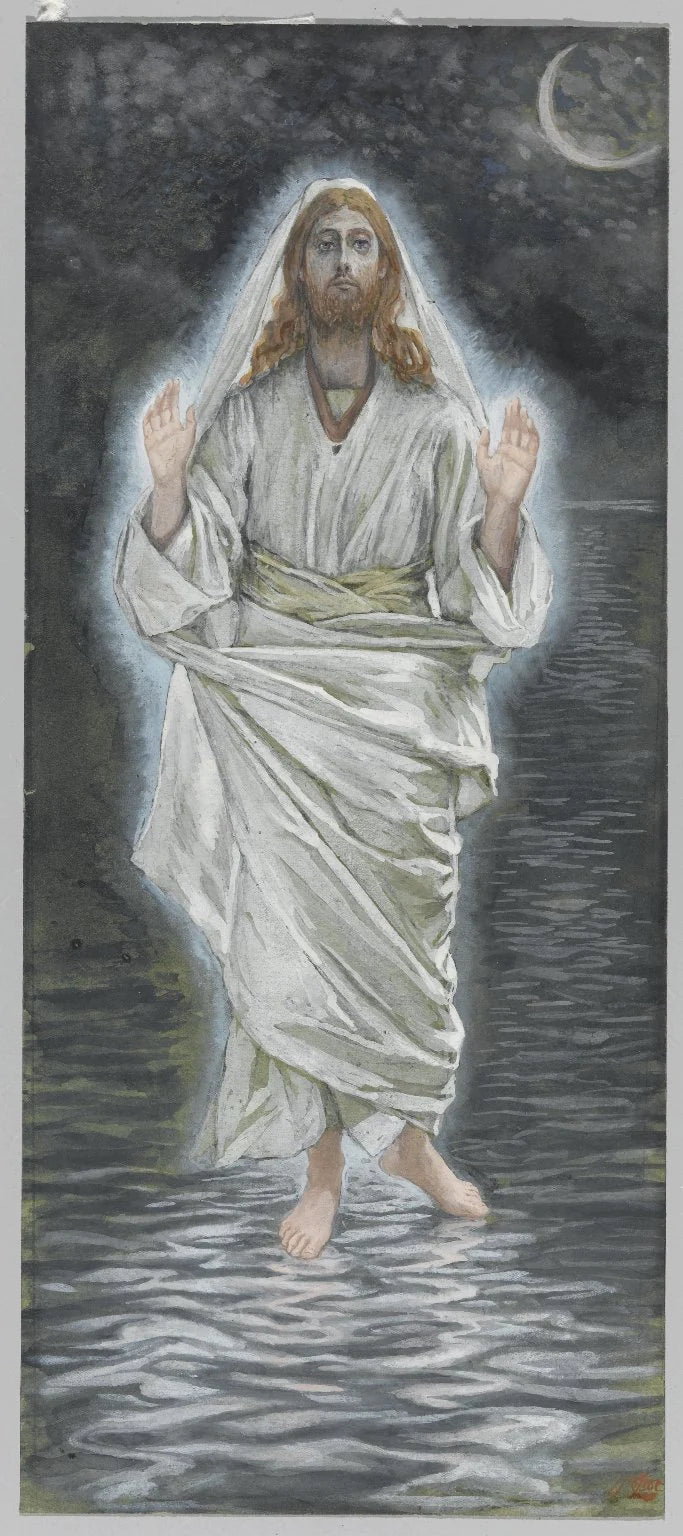
Yes, and the form is older than most people think. An illustrated life sets each scene of his life beside the passage it comes from, so it can be opened anywhere, read a page at a time and left out where people see it. The best known is James Tissot's, now in the Brooklyn Museum.
Tissot, a French painter, traveled to the Holy Land in the late 1880s to study the places, then made hundreds of gouache illustrations of the life of Christ. They drew large crowds when they were exhibited, were published as a book in the 1890s, and now belong to the Brooklyn Museum. His Jesus walks on the sea alone, straight toward you, under a thin moon.
Choosing one? We compared seven illustrated lives side by side.
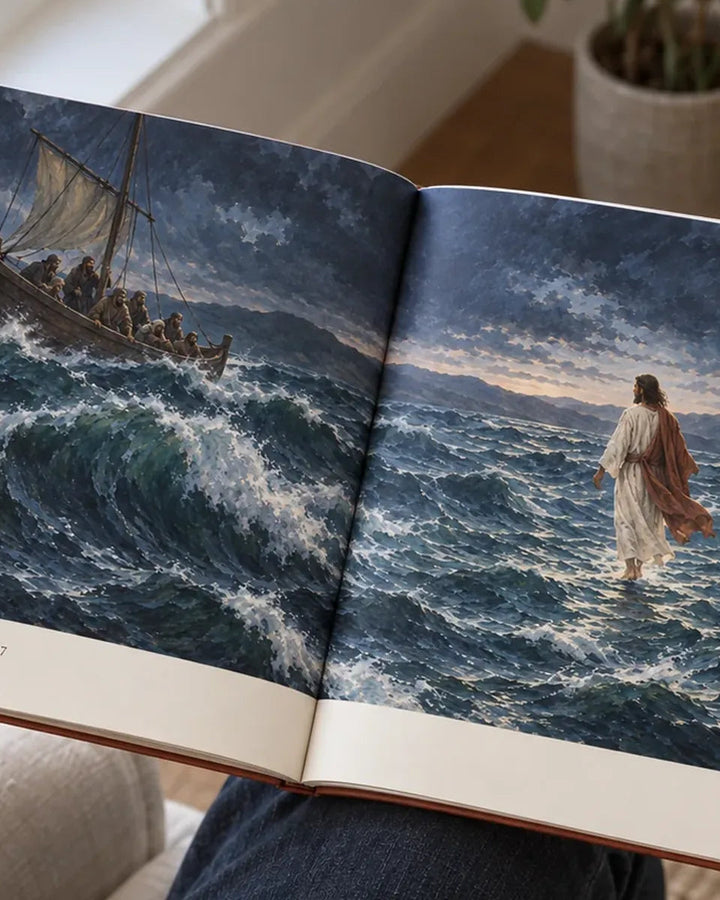
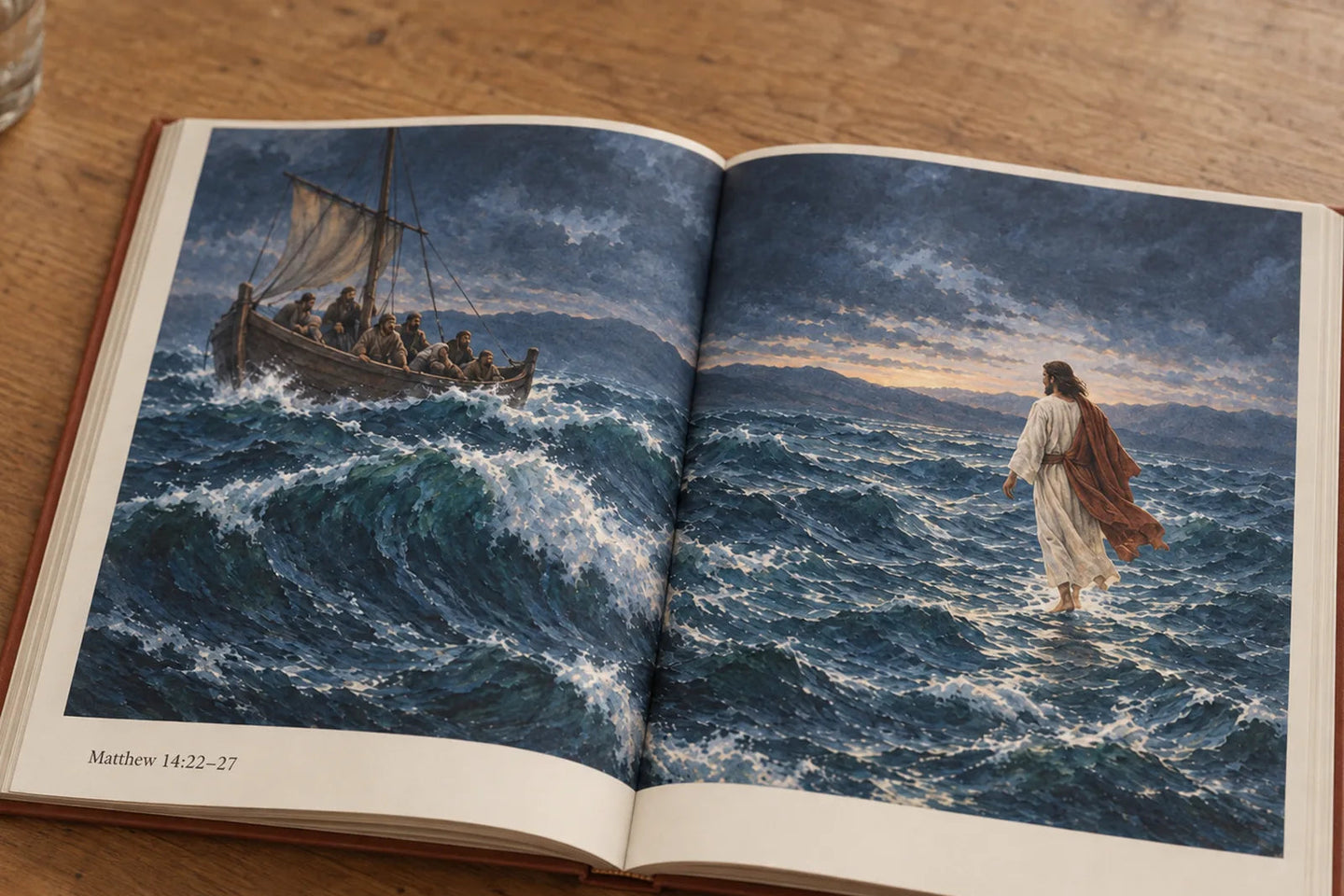
Painters have shown that night on the Sea of Galilee for centuries, and we gathered the famous paintings of Jesus that keep coming back to it. CHRIST, our illustrated book of the life of Jesus, carries the same night across two pages: the disciples' boat thrown about on one, and Jesus walking toward it across the waves on the next, with Matthew 14 named beneath.

The book runs from the manger to the empty tomb in full-page and double-page illustrations, each with its passage named, in a clothbound volume made for the coffee table. Open it at John 10 and the Good Shepherd holds a lamb against his chest, with his hand filling the facing page. Here is how the CHRIST book is bound, printed and checked.
It is a book of art, made to sit beside the Gospels and never in place of them. It reads in any order, which suits the evenings when you only have five minutes, and it sits with the rest of our books for the home.
A book within reach
Whichever you choose, keep it where you will see it. A book on a high shelf gets read once, while a book on the nightstand or the coffee table is opened on ordinary days, which is where most of a life with God is lived.
If you are choosing for someone else, our guide to Christian books for women, chosen by season works the same way for anyone you are buying for: start with what they are walking through, then find the book that meets it. For a man, see our coffee table books for men, by how they are made.
Frequently asked
What is the best book to learn about Jesus?
The Gospels themselves, starting with Mark, which is the shortest. After that, a life of Christ such as Fulton J. Sheen's tells the whole story in one book, and N. T. Wright's Simply Jesus explains who Jesus was in his own time and place.
What is the best historical book about Jesus?
For a general reader, Jesus and the Eyewitnesses by Richard Bauckham or Simply Jesus by N. T. Wright. For a fuller scholarly study, Jesus and the Victory of God by Wright or A Marginal Jew by John P. Meier, both long and demanding.
Which books of the Bible are about Jesus?
The four Gospels, Matthew, Mark, Luke and John, tell his life. Acts continues the story after his resurrection, and the letters explain what his life means. Christians also read the Old Testament as pointing to him, as he himself taught on the road to Emmaus (Luke 24:27).
What other historical books talk about Jesus?
Outside the Bible, the Jewish historian Josephus mentions Jesus in his Antiquities of the Jews, and the Roman historian Tacitus records his execution under Pontius Pilate in the Annals. Pliny the Younger describes early Christians singing to Christ. One Josephus passage is thought to have been added to by later copyists.
Are there good novels about Jesus?
Yes. Ben-Hur: A Tale of the Christ by Lew Wallace sets a fictional hero's life beside the life of Jesus, and The Shadow of the Galilean by Gerd Theissen is a short novel with the history in its footnotes. They work best read beside the Gospels.
Is the CHRIST book a Bible?
No. The CHRIST book is an illustrated book of the life of Jesus: full-page and double-page art for each scene, with the passage of Scripture it comes from named on the page, in the order the story is told. It is made to be kept out at home and read a page at a time, alongside a Bible.
Passages cited: Mark 1:1; Luke 1:3; John 20:31; Matthew 11:29; Matthew 14:22-33; John 10:11-15; Luke 24:27

Mercy & Light
Mercy & Light crea arte y libros de la Escritura para el hogar, hechos con esmero y pensados para conservarse toda la vida. Cada artículo nombra el pasaje en el que se apoya, y cada referencia se comprueba contra el texto antes de publicarse. Sobre nosotros